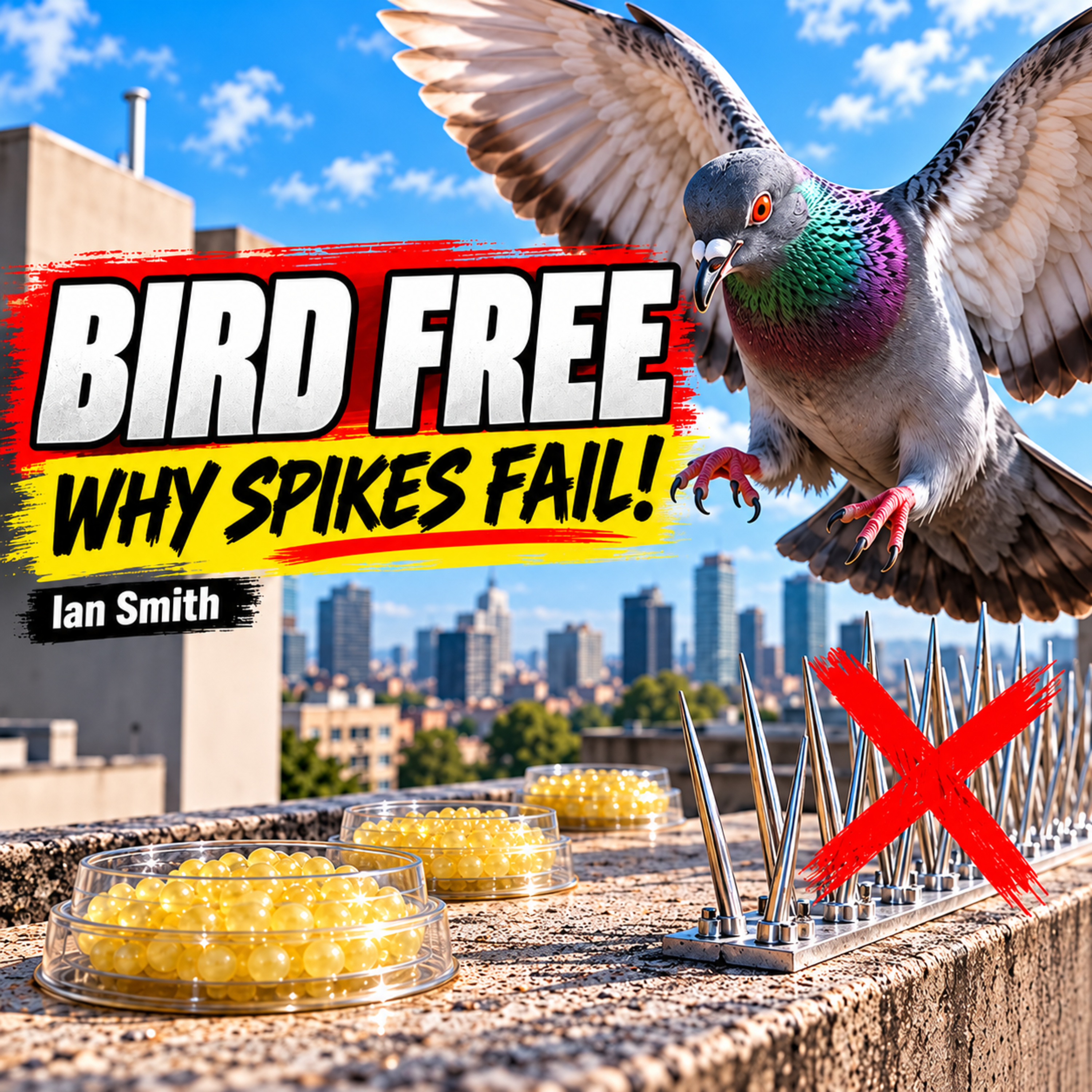
081:Bird Control & Pigeon Deterrence: How Bird Free Optical Gel Works | Ian Smith
In this episode
How does Bird Free Optical Gel work, and where does it fit within professional bird control and pigeon management?In this episode of Pest Perspectives, Shaun Muller is joined by Ian Smith from Bird Free to explore professional bird control, pigeon deterrence and the science behind Bird Free Optical Gel.We discuss how Bird Free is used to change pigeon behaviour, how visual, smell and touch stimuli contribute to its deterrent effect, and why understanding bird behaviour is so important when tackling persistent pigeon problems.The conversation explores Bird Free Optical Gel alongside more traditional bird proofing methods such as bird spikes and netting, including where different approaches may be suitable and why correct site assessment and installation matter.Topics include:• Professional bird control and pigeon control• Bird Free Optical Gel and how it works• Pigeon behaviour and long-established nesting or roosting sites• Bird deterrence and bird proofing• Optical gel compared with spikes and netting• Site surveys and choosing the right bird-control solution• Common mistakes in pigeon management• The future of professional bird control
bird free website below
Bird Free - HomeWhether you're a pest controller, bird-control specialist, technician, facilities manager or pest management business owner, this episode offers practical insight into modern pigeon control and professional bird deterrence.🎙️ Pest Perspectives | Pest Control & Pest Management PodcastHosted by Shaun Muller of Oakham Pest Control Ltd.
#AD Pest Perspectives Podcast is proudly sponsored by Powered Now, helping trade and service businesses manage jobs, quotes, invoices, scheduling and reporting. https://powerednow.com/
I'm inviting you to try Powered Now - it saves me hours on quotes, invoices, and admin. Use my link to get £50 off: https://www.powerednow.io/refer?code=FAB82F72
Pest Perspectives Podcast is a UK independent pest control podcast hosted by Shaun Muller of Oakham Pest Control Ltd. The show features practical conversations with pest control technicians, business owners, suppliers and industry experts, covering rodent control, drainage investigations, bee removal, bed bugs, wasps, commercial pest management, compliance, business growth and wider pest industry topics.
Listen, watch and learn more at:
https://www.pestperspectivespodcast.co.uk
Transcribed automatically
Hello and welcome to Pest Perspectives 81. It is Tuesday again so there's now a podcast. So just want to quickly say thanks to the sponsor Powered Now. If you want a job management software you can do your pest report, you can send you in. We actually use the invoices now with a sum up machine. That's been great. We're going more digital that way. So obviously you can still take cash payments and do invoices and paid receipts etc but if you want to check it out after the podcast i will put a link in this description then you can check it out but i just help power the show they do so this week we have on ian smith bird three how are you doing i'm doing fine sean thank you and thanks for inviting me along uh from what you've told me about sorry you came under the recommendation of karen green from john o'connor oh yeah told me to get you on she says that will make a really good podcast all right i'll have to give her a free box or two for that good old karen yeah we do good business with her i'll be showing I'll be showing one of the jobs we did with John O'Connor this evening and I'm based on our brief chat about powered now I definitely need to get that myself get more organized anyway thanks very much for inviting me on I think I guess a lot of your um listeners or viewers today will be npta members yeah we also have bpca2 listen okay as well okay anyone in the world someone can watch this in america anywhere in the world they can watch this okay good good evening jason thank all my friends thanks for popping in mate oh yeah and
good evening to martin belcher if you're there listening long time ago we did that one but understand it's all going well um yeah so anyway i i'm grateful to be invited on uh we've been selling this particular version i started 15 years ago i've been selling this particular version for 13 years the previous one was gunned with a corking gun but this is a much better product and you know a lot of people love the product some people don't really know anything about it so it's a great opportunity for me to hopefully get the message across oh definitely definitely it's uh i've heard about it never used it i don't do a lot of bird work but there is a lot of people watch the show that do a lot of bird work so it will help educate them and maybe use the product if they ever need to well more than happy to uh provide any information to help them with any training they may need it's quite simple but um yeah um anything else we should talk about i've got a presentation that i wanted to show yeah that would be good but what i want to know is obviously bird free why why did you make a product called bird free why did you come up with it what's the origin story so to speak all right now first of all unfortunately i'm not the manufacturer
i just have the rights to europe and the middle east yeah and i this opportunity was presented to me the first one was presented to me in 2011 and i had no i didn't you know i had no idea whether it was going to take off or what it was like um you know i needed to make an investment but as it turned out uh we did a job for um a local council down near gatwick airport on a car park and within a week or something we were in the local newspaper and people were calling up and so on and so forth then we got on to the uh bbc radio for that part of the country and shortly after that we were on bbc tv news uh for the south of england and then we started getting calls from virgin airways uh ikea network all kinds of people and then i realized blimey i think this must be a goer so yeah definitely got started and uh here i am 15 years later that's nice that is it's nice to hear it so you didn't actually develop the actual how it works the bird freedom i i wish i wish that i had um would you be having a lamborghini sitting outside there oh at least one probably a roll a rolls royce rolls royce i'd be calling you from my yacht in the caribbean but anyway i imagine the products used all over the world uh it is it is it is we i'm responsible
for as i say uh europe um uh middle east australia and new zealand yeah we've got um we've got another distributor responsible for americas and then we've got another guy out in asia so yeah it's used all over the world um going and going great guns now i'm pleased to say um so if we're okay with that without further ado anyone that wants any questions pop them in the chat and i'll ask ian after his presentation okay so pop questions in chat and i'll save them okay ask them after yeah all right so here we go let's get started let me bring this up um share screen there we go window where is it now is that it no um window hold on a minute oh yes now i'm not sure what i've got here and what have i got here no no that's not it i won't share it then hold on just just one moment i seem to have gone wrong here can you see that one or not i can see it but it looks like a file thing oh okay wait a minute i've obviously gone wrong here it's fine don't worry let me go back to where i was with you let me go to present let me go to
uh
stop sharing right i'm going to start again yeah there we are share screen share screen don't get this at all it certainly was so I'm just one moment please right go to window where is it I don't get this at all don't get this at all right let me right let me go to here let me go to present there it is I think that should share there we are right I think we've got it this time have we okay sorry about that sorry about that okay all right now to start with I would like to clarify the difference between bird free and traditional bird deterrent methods such as nets spikes now nets and spikes are not repellents uh they're intended as a barrier which is installed around the pigeons habitat rather than a repellent bird free on the other hand is a genuine repellent that is applied directly to the habitat itself and the multi-century effect on the bird's sight smell and touch causes the pigeon it just makes the the the site the habitat abhorrent to them uh and they will then abandon the site immediately and for good for a very long time these are two photos of London Underground stations on the left hand one you can see pigeons living inside the net you can see from the fouling here they've been living there for
some time they've created a hole in the net and they're living inside this one is below a pedestrian bridge the one on the right wire mesh has been installed up here the pigeons comfortably nesting behind it um this is um a job that we did eight years ago in a hospital um pigeons are nested on um spikes inside skylights and we removed all those and treated it with bird free and that still remains effective today um the i i i try to explain what i mean by why will pigeons always try to overcome physical barriers um i think about it from a a personal point of view if i came home and i found my front door boarded up so i couldn't get into my own home and there was no notice on the door explaining why um i would probably take a crowbar remove the boards so i could get into my own house and it's essentially the same for pigeons pigeons will always nest in the same place as long as they can successfully reproduce they'll always nest in that place once they're mature they will night roost in the same place every night you know it's their habitat it's their home if you block a pigeon's home habitat with a net or with spikes its first thought is how can i overcome this barrier and get back to my home
in other words a pigeon will do whatever it takes um to get back to its habitat you know with a net as i say it just needs to create or find a hole the size of your fist and it's back inside nowadays we get a lot of well-known companies um you know being fed up with continual continually doing remedial works and incurring extra costs and so on and so forth um so i will now just explain how bird free works on three senses of the pigeon and I will then show some videos where you can see the reaction of the pigeon immediately after bird free has been installed now as you see from this graphic bird free works on the senses of sight smell and touch and the pigeons will then avoid the treated surfaces due to that multi-sensory effect let me just explain to you the biology behind that as you probably know pigeons or birds generally see farther along the spectrum than we do they see ultraviolet light which we don't see bird tree is formulated to reflect ultraviolet light and when they look at it it appears to them like a shimmering fire and they don't like to go near they shy away from it as you will see in the videos in a moment the smell element is due to the peppermint oil in the formulation peppermint is long known as an effective bird repellent it irritates
their eyes their nose and again they don't like to go near it now the touch element is really important in where they're nesting mostly if they're not nesting the smell and the the the sight effect will be enough to keep them away however where you apply bird free to nest and you have to put it closer together for nests bottom right you see here uh 15 centimeter centers um the mother bird will often try to come back if she does that she'll touch the gel it's not runny it's very viscous it's injected at high pressure by machine so it won't harm the pigeon but if she touches it once she'll never return so in that way by working on the three senses of the bird the pigeon will immediately abandon the habitat if it tries to come back there now I'll show you now three videos which illustrate the reaction of the pigeons this is one of my customers in Dubai this job was done more than five years ago now and he sent me these photos and as you see I'll just mute that as you'll see in a moment he asked me to advise him how to install the bird free on this roof you can see that here it's very very dirty they're roosting at night below this overhang there was also some roosting at night at the back of the lower roof and so he sent me the photos and asked me to advise him
how to install the bird free so as you hopefully can see here I told him he needs to disinfect the surfaces here and to fit the bird free every 20 centimeters that's 20 centimeter centers to the upper roof and to the back of the lower roof where the night night roosting was and I advised him to apply the bird free to the landing points here at 25 centimeter centers there was no need to treat this part of the roof because we needed to focus on the areas that were providing them shelter for the night roost had there been food here um and they would you know they would have congregated here looking out for the food we would have had to treat that part of the roof but as it was that was unnecessary so um i'll just this video that he sent me this was made immediate that evening when they tried to come back to the night roost you'll see about 20 pigeons trying to return flying around in a state of confusion one or two of them land on the upper roof momentarily but when the camera pans back uh they've all disappeared and that's still clear now i think it's five and a half years now um that's good um so it's just to illustrate how they react basically um now this is comparing we're looking here at sites where there is food for the pigeons and they're congregating
every day in search of the food this is a restaurant in exeter um they had erected a net here and the pigeons not only continued to sit on the roof but they were also sitting on the net itself unfortunately this restaurant closed shortly thereafter because it was too dirty with all the pigeons turning up every day By comparison, I'll just show you an example. By contrast, Bert Free and Chris are highly effective. Now, this is... Let's go back here. This is a churchyard cum park in Watford. and people would turn up two or three times a day to feed the pigeons and Watford borough council wanted to stop this so what we did that when I went there in November 24 I counted approximately 240 pigeons on that roof waiting for their free lunch in March 25 the roof was cleaned and this was actually done by Karen Green's mob nice John O'Connor that's it and so it was a day to clean and a day to fit the dishes all over the roof at 25 centimeter centers the reason in comparison with the dubai villa where we had to focus on the places where they were sheltering in this case we had to treat the entire roof from which they could see the food to prevent prevent them going on there so this was done in march 2025 and um i went back a month later and i waited about an hour and a half to capture these video clips i think there were four attempts during that time the pigeons to try and go up on the roof and as you can see um they wouldn't do that that's still now effective today and i'll show you in a moment what it looks like after a year or so um We saw at the beginning of this presentation nesting on spikes and this was the hospital in Barcelona.
Pigeons had been nesting inside the skylight. So there were 14 skylights above the main concourse of this hospital and spikes had been fitted inside all of them and pigeons had nested on top of the spikes and they had to clean there was a cleaner there every day from morning to night because obviously you can't have fouling on the on the floor of a hospital so what we did was we went there this is may 2018 we removed all the nests all the spikes there were 16 nests there and then as it was moving right along here as you'll see we cleaned it up and we fitted these at 15 centimeter centers uh to prevent nesting and that's still free of pigeons today excuse me there's a testimonial from our spanish customer um i went there to i if anybody who wants this file um to show to their customers i can send it to you as a pdf with links to the videos rather than embedded videos because there's a big file but anyway that's that's showing uh comparison with nets and spikes now you said that martin belcher had mentioned to you that i'd gone there to help him with a job a council job yeah um i think that he he wasn't sure whether it was 11 or 12 years ago
if you're in chat i'm sure you are because he has got a question for after as well oh good okay okay so um i can't be sure without looking it up whether it was 11 or 12 years but anyway as he said he's kind enough to confirm that it's still working now and i will show you some more examples like this um now the when we author this is the only product of its type authorized for use in the uk and in the eu um under the biocidal products regulation um when we did this we had to submit efficacy data the protocol was given to us by HSE and we had to follow that.
We submitted a couple of years ago, when was it now? This was based on data recorded between 2017 and 2021. And based on that, HSE issued this certificate confirming it will remain effective for a minimum period of four years. um now by now it's quite clear that it will work a lot longer than that um on our website at bird hyphen free.com we have a video gallery uh you will see on there um about there are 10 examples and you will see amongst those you have um the biggest shopping center in italy that's 10 years and still working the barcelona hospital which we just looked at eight years king's cross station um that's now 11 years salisbury cathedral nine years we already looked at the barcelona hospital um and i'll show you the um king's cross one shortly but these are a couple of other ones that are now this is what's this 11 years old this is um a converted church in holland um you can see uh what it was like here um essentially it had been a derelict church it was converted into a flat and all the pigeons that had been in the derelict church came back and lived here went straight back onto these ledges and whatnot you can see two locations where they were nesting here and you can see how we treated this in 2015.
there's more of it and i'm in touch with one of the residents there every year and you can see this is these are some examples of his testimonials over the years confirming up until last year that was 10 years but I have spoken to him since then and he said it still continues to work this is in Pisa there's a 13th century church I love that it's so cool it looks nice isn't it and in 2015 they renovated it and you can see here These photos were taken in December 2014 when the restoration had just started, and these were taken in December 2015 after it had finished, and the last thing that we did was to put the bird free in all the infested areas.
We've even got them inside this rose window here where they'd been nesting. these are Christ and the Twelve Apostles and they were nesting behind all those statues so that was all done and I actually went there in April this year to speak to the I spoke to the surveyor and the architect who's responsible for historic buildings in Biza and they've got a lot of them and they were absolutely delighted with the fact that it was still working fine and they're using it on other, this mentions one of the other historic buildings that they'd used it on, but they've used it on several buildings there now.
So that's just to give you an idea of the fact that it will work for a long time and that's why we get a lot of, as I say, well-known companies and government agencies contacting us having heard about it saying you know can you help us we're looking for a long-term solution um now the next part i would like to show you is how to identify the treatment where you need to put the bird free to get rid of the pigeons yeah it's not like spikes where you might need to put them everywhere you have to like we saw with the villa in Dubai we focused on the places where they were night roosting not the rest of the room I will show you now two examples where they were seeking shelter and one example where they were seeking um food in fact you've already seen that one the one we did with john o'connor for watford borough council um now this was a job that i advised um a pest control customer of mine on i went i went this is a new synagogue uh in golders green in london um and uh pigeons had been living on the other side and the buildings on the other side of the road for quite some time and when this was built they started to go on to the synagogue as you see here yeah um if we didn't if we hadn't done something about this then you know it would have got progressively worse and
they'd have started nesting and all kinds of things so i went there in september 24 i went up on the roof to exit to see you know the brew what was going on the roof and all the levels below um there was nothing on the roof it was far too exposed for them there's no fouling nothing okay so the only places as you can see here what they've done is they've chosen these sheltered parts uh the frame of the roof below the roof line and the deeper ledge below that it's about 45 centimeters deep and so what i did was i i advised the customer that um he should all we needed to do was to fit the bird free on the places that the pigeons had already identified as being nice and sheltered and comfortable for them yeah um on the right hand photo here this is just a continuation round the back a long sort of it's recessed there as you can see and then you got a slightly recessed part here so I said to the customer I said look this is all we need to do you only needed about 400 dishes on this to solve the problem yeah so he came back with this marked up these marked up photos and he said oh no we need to treat everything right and I said no no you don't need to do that so he said well what if they go on the other parts of the building so i said if they
do that i'll do it for you free of charge because i you know i've done this for many years and i know that they wouldn't do that right so the job itself was done in december 24 and it took it only took it took three abseilers five hours to complete the whole thing so that was cleaning and fitting yeah and you can see here on the front here when we do it against the wall because it's very sheltered we usually do this at 20 centimeter centers these are also at 20 but the the ones on the front they're 25 because that's to stop them landing there yeah and always fit these two centimeters behind the leading edge because that way you won't see them from below they're only eight millimeters high right if you put them right on the edge you'll see them but if you put them two millimeters sorry two centimeters back you won't yeah you can see here there's one in the corner in this we put them in the corners these recess uh windows as well um so now this was you can see here you can't see any of the dishes this was after it was installed uh in december uh 20 uh 24 and this just show you here i went back two months later because i wanted to demonstrate to the client that that was working fine and i took this video you can see here um these are the
buildings on the other side of the street you can see there's a nest on this uh on this dormer for example but when you when we go over to the other side uh you can see there are no pigeons at all uh on on the bill on the synagogue there yeah so um i did send that to the guy at the time that was February 25 yeah and he didn't bother replying but I did call him in February this year he said oh yeah we haven't had any pigeons on the building since fortunately I didn't have to do any treatment free of charge man if you were to be you know you stop you know I've been doing it long enough now this is a warehouse job this is very very common problem warehouses pigeons roosting and nesting at night again there was no food in this warehouse and it was a 60 by 80 meter warehouse there about 50 pigeons living in this warehouse and fouling all the goods and god knows what right so um here i'll just these are just some of the places that we treated so i essentially what i said to the customer was look all we need to do is to treat the nests and the night roost there's no food so the only reason they're here is to shelter at night yeah yeah so that's all we need to do so he said well what about
the places in the way they sit in the daytime i said well you know the only reason they're there is because they live they live here at night right yeah they're not tourists they're not going to come back and say i remember it was quite nice when we used to live here um so we found five nests on the cable trays these are two of them we removed the nest we disinfected them and what we decided to do was to treat the nests themselves at 15 centimeter centers and then one meter either side of the nests at 20 yeah so we created an exclusion zone for each of the nests on the cable tray as you can see here we didn't treat the entire cable tray we just focused on the areas where the nest was the nest were sorry um and that was you know they that's where they'd identified as being comfortable for them they'd been nesting there for a long time and now they couldn't they didn't want to they the people say to me well why wouldn't they nest on the other parts of the cable trend it's a bit like you know we've made that place horrible for them and um you know it say they built somebody built um an oil refinery next to your house you know you wouldn't move a hundred yards up the road would you get the hell out of there yeah and that's essentially how you know
how that works if you like um this is these are we i think there were six nests in the void behind the roller shutter doors. We cleaned each of those out. And as you can see on the right here, this is looking down from the cherry picker. We fitted those 20 centimeter centers and we decided to put them up here and here above at 25 So they wouldn sit here and foul these dishes below yeah um this was these are this is these are just a selection of some of the places we treated this was a three-day job in total yeah um this was one of the the most common the most popular if you like night roost right in the corner it was very sheltered there were more than a dozen pigeons nesting and uh broosting sorry in this corner uh we cleaned we disinfected the surfaces and we put those at 20 centimeter centers um and um once when we finished this yeah um i i actually did this with a customer of mine just you know make sure that it was done as it should be and And I said to the night manager in the warehouse, I said, look, we're finished now.
Can you please ask your night staff to keep an eye out and I'll call you in a week's time? So I called him up in a week and he said, oh, yeah, we don't have any pigeons now. So I said, okay, good. So I called him in a month. He said, yeah, they've all left the warehouse. And then another week or I think it was a week or two after that, they awarded the pest controller a second contract to do the canopy above the loading bay outside the warehouse where they had a similar problem yeah this is a video showing essentially what was done you'll you'll notice a lot of this you've already seen this is this was this was the result of being there um we'll move this along that was a cable tray that was a nest that was another one of the night roosting sites against the wall um this is you already seen these uh the night roosting site up here that's one you've already seen um this is cable tray that's the warehouse itself you know because it's on cable say they have to do some cable work would you have to go back that's an interesting question right um i would say nine times out of ten i asked a customer and they say it doesn't matter you know they can still move the cables around yeah it goes on right an alternative solution is to use um cable ties where on you can you can on amazon you can get these little cable type bases with holes in the bottom where you thread the cable tie through and you can do it that way if i just meant if they ever have to do repairs cables or yeah yeah yeah no i understand i mean they as i say they can move them around
um now we've already seen this one this is the one at Watford um now I'm just going to show some information about how to use bird free yeah now this is a very very this is simply to demonstrate how you fix it with silicon this is a just treating the front of a parapet to stop when landing there so you can see here we're putting down the spots of silicon we're removing the lids from the dishes we're putting them every 25 centimeters and we're fitting them in such a way that they are two centimeters behind the front of the parapet yeah so they so they're invisible from below.
That's all very simple, but it's just to illustrate that point. Now, this is talking about how to treat nests because, you know, as we all know with pigeons, the key is to stop them nesting there. If they're nesting there and you don't stop them, you'll never get rid of them. So I'll just play this. As all bird control professionals know, the importance of eliminating nesting at a treatment site cannot be overemphasized. And because eliminating nesting is key to all bird work, I want to focus first on how to install bird free at a nesting site so that the birds abandon the site permanently.
For demonstration purposes, let's imagine that this purple area here is a pigeon nested site. I want you to imagine that the purple section is enclosed with walls on two sides here. Oh, sorry. I was trying to show, I was trying to get a better view of the... Stop. Let's go here. that this purple area pigeon nesting site, I want you to imagine that the purple section is enclosed with walls on two sides here and here, and that it's covered by a roof. In other words, that it's an enclosed space where pigeons have set up home because it offers protection from the elements and security from predators.
The section to the left here is not covered, but acts as a landing or staging post for the pigeons going in and out of the nest. Before I demonstrate how to space the dishes of bird-free at this nesting site, let's look first at how we disinfect the site. Right, so now I'm just going to... This is our installation manual. As you can see, the first page is just a two-page manual. It says stop. It's emphasizing the importance of disinfecting the site before you put the bird free down. It's a four-step process.
Remove all feces and other organic matter, in other words, the nesting material and everything. Disinfect the surfaces with a 1 to 10 solution of a suitable biocide. You know, there are biocides obviously specially for birds and pigeons. You can use, if you don't have a biocide, you can use a 1 to 10 bleach solution, and that'll work just as well. You allow it to soak, brush with a scrubbing brush, a stiff brush, and then I always wipe the surfaces dry with a microfiber cloth. I can buy those on Amazon for next to nothing because that not only gets rid of all the residual dirt, but it dries the surface so you can use the silicon right away.
And then you just put the spots of silicon down, as you'll see in a moment, and remove the lids from the dishes and stick those down. so I'm just going to show the three spacings here for pigeons low pressure day roosts landing points we've seen the parapet here this is a sign board in an airport here we see these are some window ledges in Halifax again we've put them on the front we've cleaned it up we put them on the front two centimeters behind at 25 centimeter centers and we've put one in each of these corners here because when it's raining that's the most likely place for the pigeons to seek shelter um this is a night this shows a night roost 20 centimeter centers this is the photo here is not great but this is actually a a 15th century building in Rome and you can see they were roosting every night on these beams here these wooden beams and it was a tourist it was you know a tourist attraction and the floor was covered in pigeon droppings so that was all cleaned off and we fitted them to at 20 centimeter centers last time I was there which is about three years ago that was done in 2015 last time I was there was still working and I have no reason to believe it's not now this is showing nesting this is it's it's essential to identify the nests at the site if you ask the customer if you got any nests there nine
times out of ten he'll say no and nine times out of ten he has he doesn't he doesn't know um this is actually on the partition wall of a donkey stable and obviously pigeons loved that because there was lots of um i don't know whether this is straw or hay i can never tell the difference looks like straw to me okay i have guinea pigs okay so anyway so we removed that and And we just put four dishes in the square at 15 centimeter centers. That was enough for that. This was a factory, and you can see here where the duct is going into the building.
And that's a lovely little sheltered space for nesting. And so we treated that at 15 centimeter centers. Again, I can send everything here. Anybody who is interested, I can send that. I'll get a request for it. Pete would like one. So I'll give you any details. Okay. That would be great. Anybody who needs it, I'll send you whatever you want. Let's look at how we fix the dishes. Now, this is assuming that we've done the... Right.
I've marked this. We're going to fix the dishes with silicone. I've marked the spots where the silicon will need to be applied with these yellow markers, which are 15 centimeters apart. By fixing the dishes at a maximum of 15 centimeter centers to the nesting area, that will ensure that the pigeons don't return to their nests. Note that we should fix the dishes no more than two centimeters from the edge and don't forget to remove the lids. Now let's look at how we do dishes in this case. So this is treating the staging point.
The 20 centimeter center from the last row of dishes on the nesting site. In this case, because this ledge is only 40 centimetres deep, we're fixing these at 15 centimetre centres. If the ledge were deeper, we'd be able to fix these on the landing area at 20 centimetres. The rest of the landing area can be fitted with dishes at 25 centimetre centres. So just to recap, on the nesting area the dishes are fixed at 15 centimetres centres, the first row closest to the nesting area at 20 centimetres centres and the remaining dishes at 25 centimetres centres.
That will be sufficient to prevent the birds from landing on the landing area and from returning to their nests. look at that i think that's um that's probably enough of that um right now we're moving on to the next one um now um as i mean i'll just i've already shown you most of this video i just want to show you what it looks like after a year now you see here um we can see here that the dishes of bird free are quite visible they contrast uh with the um with the roof yeah after a year i'll just show you now after a year that's what it looks like so this was eight of this year right and as you can see the dishes have gone dark with age um they still effective um but you can't really see them now right so this is the in fact i'll show you in a minute king's cross after 10 years again because that's on the euston road which is very polluted uh after 10 years they'd gone black right but they're still working and the reason is that particles will not block uv light um if you lie on the beach and you get covered in sand you're still going to suntan so this is this is um what the uh council had to say about it delivered clear long-term benefits the churchyard is now a far more pleasant place for people to visit and enjoy and that was a year or so just over a year after it was done yeah so the the great thing about this is when people
are looking for a long-term solution and they see wow that's really great um then you will get repeat business out of it, right? Now, in the case of Watford, since that job was done, they've now asked John O'Connor, well, perhaps I shouldn't mention this, but anyway, it's the town hall, and they've got a big pigeon problem there with pigeons roosting at night, and they've asked them to take care of that. So it's, you know, you can get good business out of this. This is, I already showed one of the videos that I mentioned on our video gallery, the eight-year hospital in Barcelona.
This is actually now 11 years, but this was made last year after the bird tree had been here for 10 years. The entrance to network rail offices at King's Cross Station was constantly being fouled by pigeons roosting above. right so now this was a very simple job done in 2015 as i think i mentioned to you yesterday sean network rail big wig had his offices up here and he didn't want to get on his shoes excuse my french coming in and out of his doorway there right yeah so he said oh can you get rid of that so they they put them up there in april 2015 these these photos were taken over the years just to show that there were no pigeons there um and um you will see now if we move this along right so this is what it looks like last year after 10 years you can see how dark they are yeah um and this is the testimonial from the network rail guy responsible for king's cross station you'll see that we installed bird free in front of the high level officers in april 2015 to prevent pigeons from fouling the area below having inspected the site last week i confirmed bird free is still keeping the pigeons away 10 years later so that's that that's what we we did that last year now as it turned out right when i went to see the guy and he said oh yeah that's great so he said actually we've got more work we we need you to do here right so in uh january 2026 uh we did uh some interior work mostly at the harry potter experience i was amazed apparently they've got eight was it
no, 4 million visitors a year to see platform 9 and 3 quarters. I've never read the books, but anybody who has will probably know. I've seen a lot of videos where people try and run through the wall. They actually got a luggage trolley halfway through the wall or appears to be halfway through the wall so that one that one of the things you can get your photos taken with but anyway so we identified the places around the station interior and exterior this is showing what we've done in 2015 now we're going to move Now this is one of the areas where this is the platform 9 and 3 quarters.
This is outside where they were on the sign boards, on the edge of the underground station, various other places that we identified. This is back to Harry Potter. where are we anyway the bottom line was this was all there's only about 900 dishes because we just identified the places where they were you know where they like to frequent and I think what did he say there he said I missed that again anyway that the bottom line was he was delighted there we are exceeded all expectations no pigeons around Kings Cross Square nor on the entrance of the underground so to my surprise and light shortly after that he prepared this report and sent it out to the managers of all the network rail stations in the uk and we are we have got other business as a result of that um and um long may it continue um that's good that is you couldn't ask for a better testimonial than that sending him around the country but really he's got a lot of data to back up yes he has been working for as well he's not just said oh i put these in six months ago he's got proper data yes well that it's always good to go and visit your clients because often they'll say oh that's great and we've got some more work so um that's why i need to get that powered now so i can keep abreast of all my cars um a bit of a plug for your sponsor there sure um so anyway as i say a growing number of companies
and public bodies are turning to us uh we've since done uh two stations for network rail where they were completely refurbishing the station and they decided that they were just going to put the bird free in while they had the scaffolding up so they wouldn't have any you know wouldn't the pigeons wouldn't return but it is true that more and more companies and you know government bodies turn to us in search of a long-term solution after finding traditional methods ineffective um you know for the client as i say this results in the continuous cycle of corrective measures and additional cost one good example is red bull racing they contacted us last year and the first job we did for them was in june 25 and since then they've asked us to do four more sites it's good so that's how mercedes benz we've done a number for them um as i say network rail national highways some bridges we've done for them um so that i guess is um more or less what i wanted to present um i've put on here my email address and my phone number um so by all means um let sean know if you like to receive stuff by email i mean i can i don't have to send you i mean if i send you this file it's huge it's like was it 1.4 yeah 1.4 gig gig right so but i can send you
these different files with the videos shown on youtube links so that's a much smaller file i can send those to you in pdf so anything that you're interested in and i will i will say this right um you know it's my job to get anybody who wants to use bird free involved to provide them with training uh on-site training if required to go to site and help them with a survey so they can determine how much they need so they can quote a price you know whatever it is yeah um to get started because once you you know it's not rocket science you know once you've done two or three jobs you pretty much know everything you need to know um okay it's a question of being a bit smarter than the pigeon and um if we can't do that there's no hope for us i like watching the videos where the birds come flying and disappear i think it's really good
um so i'll stop sharing now yeah um if i can if i stop sharing yeah it's done good all right so i'm back i'm back with you so um if any if if you have any questions that have come in so far sean i'm happy to answer them now yeah there is one here for martin but i'm pretty sure by by by watching that seminar i know the answer to it good it's pots off it's the covers off yeah people sometimes people sometimes don't do that i mean it states you quite clearly on the installation manual anybody who wants an installation manual of course i'll send you that but the first few slides of that and the videos are quite handy to show to customers because you know they then get an idea of you know how does it work yeah and they see how it works you know they see that that it does work from the videos it's just a it's just like a five or six page proposal you know presentation that you can send to your customers as a pdf you know because if they don't really understand it then they're like oh i don't know i'll just try it's a lot of the time it's uh i imagine from some perspectives on the government and historic sites it's more of as well yeah it's basically for all parts it's headed into it it's not spikes or you know netting
gone up it's yeah it really looks hidden so that's probably a good selling point too we do we do get quite a lot of work with listed buildings you can see Salisbury Cathedral on our website, there's a job we did nine years ago but we get quite a few listed buildings in the UK and in Europe in fact I was contacted yesterday by a local government in the south of Germany where they've got some looks like Disneyland castles that they want to protect so hopefully we'll get some business there as well um anyway um again martin thanks for turning up and thanks for your um comments on that um are there any other questions i can ask there is a question but i i don't think you could really you'd have to speak to him by email Ricky was just asking what's the rough price 900 dishes is that is that Ricky down in um where is it down in oh Ricky Hutton right okay I was thinking of a different Ricky yeah I think I think Ricky Hutton and I have spoken in the past he's very he's a very inquisitive bloke he's until yeah all right you you may have spoke to him you may have spoke to him so ricky the answer is right it depends who you buy it from yeah um our main distributor is kill germ um if you want
help with pricing drop me an email and i'll kick them in the shins and tell him to give you a good price yeah yeah i didn't think that would be something you could actually say on the podcast because it's all dependent it is dependent you know people's initial reaction is oh it's much more expensive than spikes right but as you've seen a you don't need to put it everywhere and b it lasts a hell of a long time yeah yeah so it really is a situation where you're looking for customers you're not looking for customers who want the cheapest solution you're looking customers who want a long-term solution yeah um that is discreet and in any event by the time you've paid you know they give labor access equipment whatever it is right it's really not it's really no more expensive yeah that's true so obviously martin has replied now and he's put he's put Who's sure to disinfect prior?
Yeah. One of the biggest points that the disinfection is key. Absolutely. There are two keys. One is disinfect before you start, and the second one is respect the spacings.
Have you ever had jobs where people have installed it themselves wrong because they've spaced it wrong? Have you ever had anything? Yeah, yeah, yeah. we we get i get people um i would say probably i get maybe nowadays um not so many i would say probably half a dozen maybe a few more a year just contact me and say oh yeah you know we've used it doesn't work send us and i just say well send me some photos right and you know most of them they swear blind that they put it at 15 centimeters and i look at it and it's clearly 30 centimeters okay right so you know it really is a question of a following the installation manual and the ruler out like in that video yeah the ruler didn't they yeah exactly but b understanding where you need to put it you saw on the roof in dubai you saw on the synagogue right we didn't need to use that much we just needed to focus on the places where you know the habitat of the pigeon basically yeah yeah um so um any more for any more questions before we any more any more questions anybody no uh but ricky has ricky did put up agreed it's great for listed building and that's a good gap in the market so yeah yeah yeah any more questions anymore you can always ask
i'm all right now um so i will be at the um uh what is it now the it's milton keen's isn't it ah well i'll see you then i'm i'm always there oh yeah i help at that i i uh that's the first year helping last year so i will make sure do you have a stand or do you just do you have a stand i i will i will probably i'll usually go on the kill germ stand with them ah yeah i know i may have i don't know were you at pestex yes i may have said hello to you without knowing i was wearing this hoodie at pestex so i don't know if you remember me i i think i now i do actually i was only there one of the days and my colleague was there the other uh for the second i reckon i'm pretty sure we asked and now i think about it i was there on the first day were you on that first day yeah yeah yeah yeah yeah yeah now i think about it i remember that and i think and you definitely mentioned something to me about the podcast i did yes i always do okay people i was like do you want to come on i don't know if i asked you about the podcast i don't know i don't know yeah so um yeah so all good and i think you're going to be posting this on your on your web on your website or something are you it goes on the website it will it's live straight after this podcast it's live on youtube okay it will be
i stay on facebook and after 30 days i'll have to re-upload it um linkedin it just stays on linkedin but after this i will upload it and it will go on spotify apple podcast and all of them but it does the podcast does quite well on Spotify and Apple on Spotify and Apple but I'll keep you updated with feedback let people let me know what they think to it but they're hoping you get a lot of interest out of it because the good beneficial product it seems very good it does from yeah it is it is good and I I reiterate anybody who wants hand holding doesn't even if you've never done bird control work before.
So I know a lot of people will just sub it out to somebody. It is not difficult to do. It's not difficult to do. Just requires a modicum of common sense and a modicum of training. And being okay with heights at times. Yeah, obviously. I'm terrible at heights. well that's that's what i was like when i started this business but obviously i had to overcome that well yeah exactly doesn't bother me now but yeah thanks martin and thanks it's another great session cheers okay thanks everyone for watching and i will um yeah yeah i will put the points up on the british press register give me a day or two people get a point for watching this if you're a bassist you can tell them you watched this with the bpca bpca tell them what you've learned okay if on the british press register i will make a little quiz based off okay i do though is i also make questions sometimes to catch people out you know things you say sometimes to see if they're actually listening because some people think quizzes, they can guess.
But sometimes they also stick in things you've said rather than just all 100%. Obviously, I put the education in, but I put stuff just to make sure they've listened to the podcast. Some people can just click, oh, I'll go at this. Get a free point.
I'm at 76 for this year. I need 20. I like to learn. Well, look, do forward me over any inquiries that have come in to you. But I will put your details in the description after. I couldn't put it in to start with because when you upload it to Facebook, if you put links in straight away, they don't like it. But if you do it after, it's okay. Okay, got it. Anyway, I'm sure you can find me bird free. Just Google bird free. If you need anything, let me know. But, yeah, thanks, everyone. I'm ending the stream now.
Just stay on the line for a minute. Okay, will do. But, yeah, so thanks, everyone, and I will see you next Tuesday at 8 o'clock. Adam Holt's on next week. He's been on the podcast before. Okay. And, yeah, thanks, everyone, for watching, and I'll see you all soon. See you next week, basically, if you come in. Right, thanks, everyone. See you in Melton Keynes, if not before.
Sponsored by


 Spotify
 Apple Podcasts
 Goodpods
 YouTube
 Amazon Music
 Audible
 Castbox
 Castro
 Deezer
 Moon FM
 Overcast
 Pocket Casts
 Podbean
 Podcast Addict
 Podcast Republic