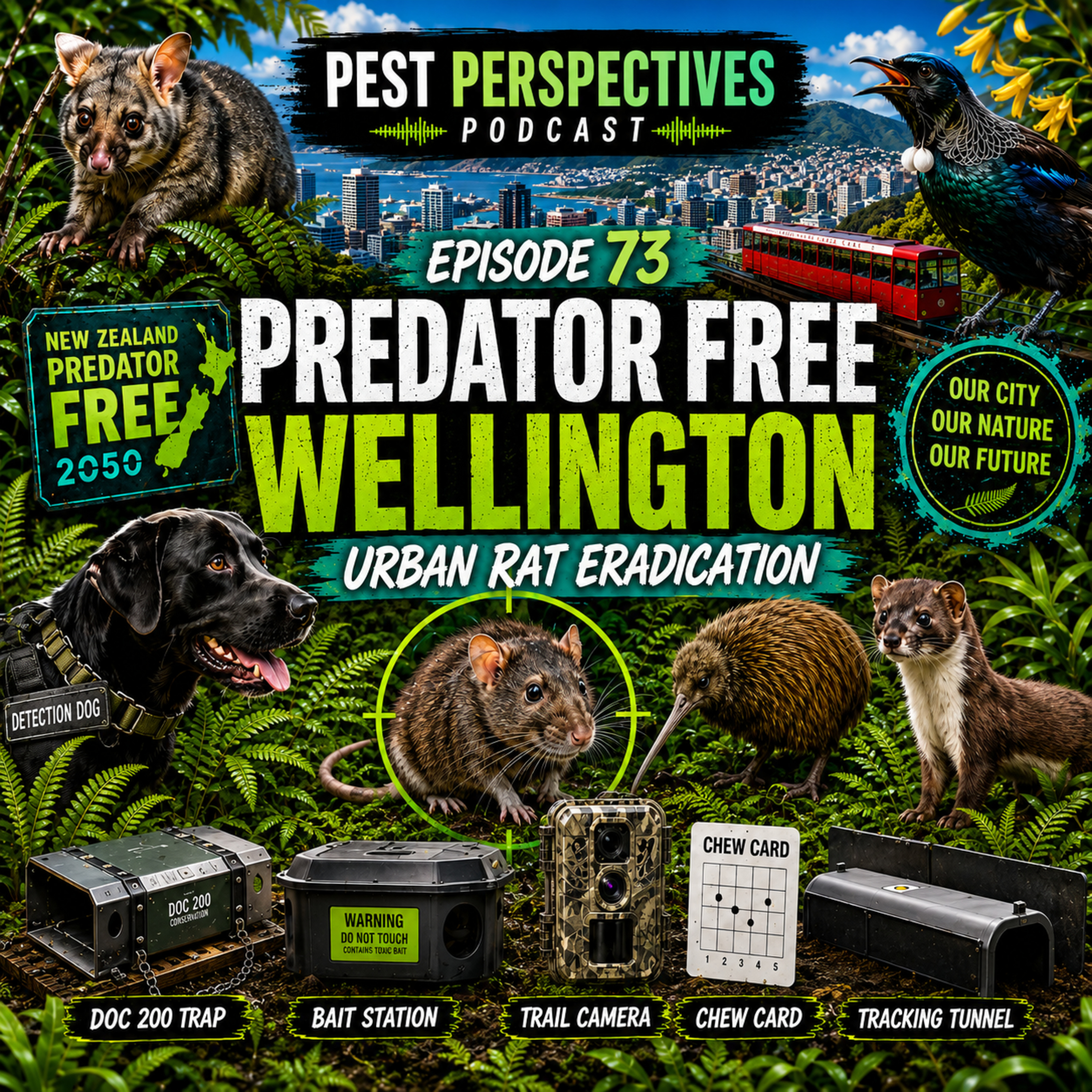
073:Rat Control in New Zealand: Inside Wellington's Predator-Free Mission | Predator Free Wellington
In this episode
Rat Control in New Zealand: Inside Wellington's Predator-Free Mission | Predator Free WellingtonIn Episode 73 of the Pest Perspectives Podcast, Shaun Muller is joined by Emma from Predator Free Wellington in New Zealand for a fascinating conversation about one of the world’s most ambitious urban predator eradication projects.
Predator Free Wellington is working towards removing introduced predators including rats, mustelids and possums from New Zealand’s capital city, helping protect native wildlife and allowing threatened species to recover.
Emma explains how the project operates across an urban environment, working directly with residents, volunteers and local communities to establish extensive networks of bait stations, traps and monitoring devices.
The conversation explores the challenges of controlling and eradicating rats in a city, including alternative food sources, neophobic behaviour, bait and trap avoidance, access to private properties and the difficulty of locating the final remaining animals once populations have been significantly reduced.
Shaun and Emma also discuss why trapping alone may not always be enough to achieve eradication, the role of toxic bait alongside traps, the use of DOC 200 traps, trail cameras, detection dogs, chew cards, tracking tunnels and automated lure systems.
Emma explains how data plays a major role in the project, with captured animals examined to help build a better understanding of local populations, including age, sex, breeding status and genetics.
The episode also looks beyond pest control and into the wider impact of the programme. Predator removal has helped native bird populations recover, while community involvement has brought residents and volunteers together around a shared conservation goal.
Topics discussed include:
• Predator Free Wellington and Predator Free 2050
• Urban rat eradication
• Integrated pest management
• Rat trapping and toxic bait
• DOC 200 traps
• Neophobic and difficult-to-catch rats
• Trail cameras and pest monitoring
• Rat detection dogs
• Chew cards and tracking tunnels
• Automated lure systems
• Community engagement in pest management
• Protecting New Zealand’s native wildlife
• Non-target species and humane pest control
• Data-led pest management
• The future of predator-free cities
This is a fascinating episode for pest management professionals, conservationists, wildlife specialists and anyone interested in how large-scale pest eradication can be achieved in complex urban environments.
Can an entire capital city really become predator free?
Predator Free Wellington is working to prove that it can.
Any predator free wellington questions email - [email protected]
The ‘contact us’ page on our website also links our social media accounts - https://www.pfw.org.nz/our-project/contact-us/
For the blue print click the link below
Our urban predator free blueprint (2024) • Predator Free Wellington
#ADPest Perspectives Podcast is proudly sponsored by Powered Now, helping trade and service businesses manage jobs, quotes, invoices, scheduling and reporting. https://powerednow.com/
Pest Perspectives Podcast is a UK pest control podcast hosted by Shaun Muller of Oakham Pest Control Ltd. The show features practical conversations with pest control technicians, business owners, suppliers and industry experts, covering rodent control, drainage investigations, bee removal, bed bugs, wasps, commercial pest management, compliance, business growth and wider pest industry topics.Listen, watch and learn more at: https://www.pestperspectivespodcast.co.uk
Pest Perspectives sponsor opportunities
https://www.pestperspectivespodcast.co.uk/media-kit/
Transcribed automatically
Hello and welcome to Pest Perspectives episode 73.
Sorry, I messed it up. The Pest Perspectives is sponsored by Powers Now, a job management software program. It just helps us fund the show, buys new cameras, pays for this software, things like that. So if you want to check it out, there will be a link in the description after. But this week on episode number 73, I have a very interesting guest from New Zealand where they've got a very interesting project. And I've had a lot of people message me saying they're really looking forward to this one.
So I have on Emma Wow from Predator Free Wellington in New Zealand. You're our first guest from New Zealand. You are. Awesome. Thanks for having me, Sean. Right, no, thanks for coming on. Thanks for going into work early as well. You're good to go into work early. No problem. What time is it there? It's just past 7am here this morning. 7am. It's 8 o'clock here. Yeah, it's nearly. Oh, cool. So, hello, Jackie. So, do you want to briefly kind of, if people haven't heard of Predator 3 Wellington, could you give a brief summary of what it is?
because it's very interesting. Yeah, sure thing. So we're based in Wellington City, which is the capital of New Zealand. So we're just down the bottom of the North Island of New Zealand there. And it's an urban project and I guess it's a bit of background. So the New Zealand government back in 2016 set a target to get rid of a bunch of introduced predators from the whole country is the goal. So that includes three species of rats, weasels, stoats, ferrets, brush tail possums, and they've recently added feral cats and mice onto that list as well.
So it's quite an ambitious goal. But the reason that they've set that goal is that nationally we don't actually have any native mammals other than two species of bats. So our native wildlife has been pretty devastated by the human introduction of these pests. And so we've had a lot of birds go extinct. About 30% of our birds went extinct after they were introduced to the country. And yeah, so nationally, we're basically trying to protect all of our native species. There's about 4,000 threatened species in the country.
And so by controlling and removing these predators, that will allow them to thrive and hopefully recover. So to kind of achieve this goal, there's obviously one of the challenges is how do we do this in cities or places where people live? like Wellington. And so we're sort of one of these, one of several prototype projects that is sort of trying to work out a methodology for how we get rid of rats, muster lids and possums from places where people live. And we were set up back in sort of 2019, we kicked off in the Miramar Peninsula, which is sort of the eastern part of Wellington City.
And we've got a five phase project working across the city from east to west. And the goal is just to progressively work our way through all these different suburbs and neighbourhoods and get rid of these introduced predators. And yeah, we're in phase two at the moment. So phase one is basically complete and we're into phase two now and just working our way across the city. So yeah, it's a huge sort of community driven project. We're a not-for-profit organisation supported by council and government and some other foundations.
So yeah, that's where we're at the moment. I mean I'll be honest people if you want to go and read the blueprint I mean this is like a military operation I don't mean it that way just the mass information and different systems you've got in place to to do it it's and it's not a final document it's an ongoing document that changes according to data but it's honestly it's very well detailed if you want to see You can just Google Predator Free Wellington Free Booping. That's the one. Yep. And you're, yeah, very well detailed.
It is. So there's a brief overview of the project.
So I'll get to some questions. Yeah, cool. So there we go. Right. Here we go. Was there a specific moment or experience that made you realise you wanted to dedicate your career to conservation?
I always sort of loved wildlife and nature as a kid. I loved animals and knew I sort of wanted to do something to work with them or help them. But as a kid, I wasn't really sure what that would look like. And then probably as a teenager, I started sort of researching what careers were available and learned about conservation and ecology. and that, you know, you could actually make a career out of learning about animals and protecting ecosystems. And, yeah, I found that really exciting and really inspiring, something where you could sort of make a difference.
So, yeah, went to university and studied that and then kind of got stuck in, and I've been doing that ever since. So, yeah, it's been really rewarding. I really enjoy it. Very nice. Did you have any, you know, before this project came along, did you have any interesting roles you did before this particular role that you could mention or anything like that? Yes, I worked, my kind of first job when I was studying was as a sort of like an education ranger working with kids at Zealandia Eco Sanctuary which is a predator-free fence sanctuary in Wellington where there's a lot of native wildlife and so we'd sort sort of bring kids in and talk to them about our native species and how we look after them and protect them.
And then after that, I worked for the New Zealand Department of Conservation, which manages all of the conservation land across the country. And I really love that. I got to work on some offshore predator-free islands and you sort of got to see the real impact of removing these mammalian predators and what that has on the wildlife. And it was just incredible. So yeah, that was probably my favorite thing i've done so far and then yeah i've been with predator free wellington for the last seven and a bit years now which has flown by so yeah that's that's the journey so far no it's very it is interesting because obviously it's well because obviously these these projects you have to you're quite official when with the government and everything you are it's like proper official so it's so it's nice it definitely helps it does because obviously if you've got no birds we've got birds everywhere pigeons, do you have pigeons there?
no? yeah we've got a native wood pigeon called the keridu beautiful big bird god they're everywhere here you know on houses you've got solar panels you can put them on generally if you don't proof them up around the solar panels they'll make homes under them oh no way It's very known. That's what they do here in the UK. Oh dear, we don't have that problem yet. No, but it's very rare you don't get that. But yeah, we've got a lot of pigeons. A lot of people call them flying rats in this country. Oh dear.
We do have rock pigeons in the city, which are not native, but yeah, yeah. Yeah, we've got a few of those around too. That's interesting that is. Right, let's just go on to the next. I'm actually putting questions on the screen this time. Yeah, cool. I am. Right. Working in predator control can be tough. How do you handle the emotional side of lethal control while still maintaining a love of nature? Because obviously it is death at the end of the day and you use a lot of traps. So you and your team are going to have to physically remove the dead animals from them.
And obviously there's a greater goal of clearing them, but you still, there is that emotional connection where, you know, they are vermin and have got to go. But, yeah, it's kind of, yeah. Yeah, it definitely has its tough moments, eh? I think I never really liked the idea of killing things and I've got a huge amount of respect for the animals that we unfortunately have to remove. But I think for me it's just reminding myself why I'm doing it And yeah, kind of having this purpose where you're helping all of our native species recover and survive.
And unfortunately, the two just can't coexist. You know, these predators will just decimate them. So by removing them, we're helping these other species, which, yeah, is kind of makes it feel worthwhile. I think also seeing that the benefits are really tangible. So as soon as we remove the predators, we see the bird numbers just skyrocket. it. I think in the area that we've been working the longest, native bird detections have gone up by like 136% or something like that. And some species, it's over 500%.
So you're kind of, I think the community and us when we're out working, we'll see, you know, a noticeable difference from what we're doing. So that's kind of a nice trade-off, I suppose. It's sort of not unpleasant. It is unpleasant and it can be tough some days, but you have this kind of nice feedback reward which sort of makes it feel worth it which is really nice yeah i mean yeah obviously i don't know what it's like because i didn't realize to try to bring up an extent of the issue um but yeah i don't think they're really wiping out birds here they're not rats but yeah that's on a big scale though that that's happening in new zealand but it must be rewarding to see the birds returning nature returning as such properly yeah it's very cool so obviously I'm not going to put this one on screen because I can't find it but I do remember that I did send you this one how do you convince all the people to let us put traps down and bait boxes and poisons in the gardens etc how do you convince people that must be quite difficult Yeah, it's a massive ask because we basically go door to door and talk to residents and basically say, you know, we've got these traps in these bait stations.
We want to remove the predators. Is it OK if we put one in your garden and we come and visit? You know, it might be every week for several months until we've got rid of all of the rats in particular. And, you know, these are their private spaces, their properties. and it is a lot to ask, but I think for us, it's sort of, we're building on decades of conservation work in Wellington that came before us. So there's been, there's a huge amount of awareness about the predator free movement within Wellington.
Things like that, Zealandia sanctuary that I mentioned where I used to work, that's been kind of reintroducing native species to Wellington for decades now. And so people are seeing things like, we've got an endangered parrot called a kaka, and they're kind of all over Wellington now, which is amazing. And so people sort of see them and they want to protect them. And so luckily we're kind of working off the back of projects like that that have been doing conservation stuff in Wellington for a really long time.
But also I think it's just we'll sort of go door to door and have one-on-one conversations with each property and we'll sort of chat to them and say, you know, what are your concerns or questions and what considerations do you have for your property? Are there any hazards or have you got pets or kids or whatever? And we'll just sort of work with them and have a bit of a back and forth. And also look at the benefits for them. Like I think for different people, there's different reasons they want to be involved.
And for some, it's bringing back the native wildlife. But for other people, it's because, I don't know, I had chats with people who the rat had chewed through the hot water cylinder pipe and flooded their house. And they had tens of thousands of dollars worth of damage where they had to rebuild their whole kitchen. and things like that. So there's, you know, there's multiple reasons that people want to be involved. But thankfully, it actually hasn't taken a whole heap of convincing from us. I think people are already behind it, which is great.
That's nice. Is there a minority of people who don't want you to do anything and they love everything? Is there a minority that won't let you in the gardens? Yeah. Yeah, there's a small couple of maybe percentage of people that don't want us to come on the property. which is, you know, totally fair enough. And that might be for a bunch of different reasons. It might be privacy or the access is restricted for whatever reason, security, all sorts of things. And that's okay. We kind of fully respect that.
It's a lot to ask of people. And luckily with the kind of device network we have, if we don't have every single property, generally we can manage by just having things on the neighboring properties, for example. Yeah, because they run through gardens, don't they? Yeah, exactly. So as long as we've got a device every sort of, I don't know, 50 metres or so, generally we can get the coverage that we need to get rid of the rats. Do you just put loads of – this might be a – it's a bit of a joke over here.
In this country, when we get rat issues in the gardens, people use bird feeders in general to feed the birds. Well, when they get a rat issue, you just chuck in loads of bird feeders to attract them. but because i've had jobs where i said you do know you caused the problem don't you know yeah it's a bird feed isn't it yeah yeah i mean that's that's definitely one of the urban challenges that we've got to work with is alternative you need to use bird feeders for your wildlife don't you yeah i mean luckily for us sort of the the native wildlife will do pretty well on its own And once we remove the predators, a lot of them are nectar feeders or they'll feed on the fruits of the native trees and that sort of thing.
So we're not really needing to supplementary feed. They can sort of do their own thing. I think people that do the traditional bird feeder thing with bird seed, it tends to attract more of the introduced bird species. A lot of UK bird species. We've got pinches and sparrows and rock pigeons as well. So yeah, but luckily the native wildlife, once you remove the predators, as long as they've got some native plant species, they do pretty well on their own. But yeah, definitely the alternative food source thing is a challenge.
And sometimes we'll have to chat to the residents and say, look, do you mind holding off feeding the birds just for a few weeks while we kind of get the rat numbers under control? Because it is, I guess they're not going to need to go and eat our bait or the lure from our traps if they've got heaps of other, you know, food from a bird feeder. So yeah it definitely one of the things we got to work with in the urban space Definitely true Because I imagine a lot of it is oh I got free pest control That the biggest one yeah totally yeah as soon as we say it free a lot of people are like right where do i sign they on board which is great because there are a lot of people paying for this service um you know through other organizations that rent to kill and stuff so so yeah here's a question i don't know whether you can answer it or not how do the pest control companies feel about this project because obviously it's free how do they feel you don't have to mention any names how do they feel about it obviously do you know are they have they moved two different pest species because you'd have to yeah exactly yeah I think um I'm not sure I won't speak for them in terms of how they feel about us but I know that um they've definitely still got their work cut out with because we don't control or we're not removing mice as our target species we've just rats and mustelids and possums so there are still mice about which will definitely keep them busy i'm sure um and then they've got you know the insect pests and um other things that they target
so yeah hopefully there's still enough room in the market for both i just thought i'd ask because a lot of people would want me to ask that because a lot of people did ask her you know yeah yeah no i think i think there's still it seems like there's plenty out there to keep them busy too and we've actually had comms with them where they'll you know they might let us know if they've detected a rat in someone's bait station in an area that we've thought maybe was rat free and so then we can go and respond so um yeah we have had some comms back and forth with them which just really helpful.
That's good to hear. So obviously within the, within the, with the residents side, what's the most surprising thing you've learned about the Wellington residents since you started walking on, you know, working on their doorsteps?
Yeah, good question. I think probably the main thing for me is just how dedicated they are to this mission and how supportive they've been. As I said before, it's sort of, it's a lot to ask to be coming on their properties every week but um people seem to really want this thing and and to the point where they'll go out on their weekends and volunteer their time to help out so we've got I think across Wellington there's about 2,000 and something volunteers um out there that will just you know they'll go out on their Saturday and they'll check a line of traps or they might have a couple in their backyard that they check once a week and they'll report to us or to their community group what they're catching and so it's it's actually kind of a whole region-wide um effort where people are putting in their own time to help and we've got some amazing volunteers um in our predator free areas too and they'll go out and check our trail cameras and then they'll process all the images themselves and tell us if they've detected anything of concern so um yeah it's been really amazing i think just to see how it's brought the whole community together with this mission and how willing people are to give up their time to help it's really cool that's nice it really is it's a it's a massive project though it really is it's um yeah i think i think it's great it does
there's still more questions to come but i think it's i think it's quite fascinating from uh you know because it is at least pest control but it is it it's illogical and everything it's the whole package it is. Yeah, it's a good challenge. My daughter's getting that paper there. So we've here's one for you. If you could see one extinct or rare bird species return to your own backyard in Wellington which one would it be? I mean any of the extinct species I'd love to have back but in terms of one that I think is actually achievable for Wellington.
My favourite bird is a forest songbird called the kōkako. And it's this sort of beautiful grey bird that sort of lives in the forests and it's got this sort of haunting organ-like song which is really beautiful. And yeah, they've been gone from Wellington for, I don't know, probably over 100 years or so. Wow, that would be cool then, wouldn't it? Yeah, I'd love to have those in my backyard. That would be pretty amazing. I don't even know how you could do something like that. Even if you've wiped out, you'd have to find some, wouldn't you, to start with?
Yeah. I don't know where else they live. Do you know? Yeah. I mean, there's a lot of them. There are some populations still around the country, but they're generally, I think they'll only survive where there's predator control happening. So they're really vulnerable to possum and rat predation. And so they basically live on offshore islands that are free of predators or there's a few sort of mainland reserves where they're hanging in there. And I think the numbers overall are increasing, but they're still threatened.
So yeah, but once Wellington's fully predator free, I can't see why they wouldn't thrive here as well. So another conservation thing here, I suppose, is that we've got pretty good at translocating species and moving them around. So once the kind of habitat becomes suitable again, And we can take, you know, a group of individuals from somewhere else where they're doing pretty well and move them here and reintroduce them. And then, yeah, hopefully they'll take off here as well. But, yeah, that's something that I think is actually hopefully pretty feasible in the not too distant future.
Hopefully. Hopefully that happens. Hello, Darren on LinkedIn. Thanks for watching, mate, as always.
Right. also Wellington is becoming the world's first predator free capital what makes the urban environment harder or easier to clear than the offshore island I think probably in some ways it's harder in some ways it's easier I think the stuff that makes it easier is probably how accessible everything is like a lot of the there's projects that are similar to us, but they're in the sort of back country in the, in the mountains or in the forests where, you know, you've got to get in a helicopter to go and check your traps or you've, you know, you've got to be a day's walk away or somewhere really remote.
Whereas for us, basically every site we go to, we can drive or walk to really easily, which means we can check things really frequently. And that makes life a lot easier. Probably also having all these eyes and ears on lookout. So we've got, you know, tens of thousands of people who are keeping an eye out for these predators and um if you know if we've got an area that's predator free and they spot something they'll let us know so we've got probably i don't know i'd say several public reports of sightings that come in every week and we'll go and investigate them um we've got a on our team we've got a detection dog handler and two rat detection dogs oh yeah that's really cool and so people reckon they've seen a rat will send the dog squad in and they'll go and check it out and see if they can determine if maybe it is a rat and it's snuck in on a car or something like that or whether it's um was just a mouse or something like that um okay so that's really cool is that just for detection only or do they actually wrap the rats the dog just for detection yeah so they'll sort of tell us where the rats are going where they're moving they might be able to identify the den for us and then that just helps us go in and sort of target the right spot.
So that works pretty well. So, yeah, definitely having everyone on look at helps. That's good. Do you, like, obviously, do you use any digital boxes for areas you can't get too easily, like, you know, connected to the internet? So digital technology boxes, do you use anything like that? We have tried a few of those tools, but luckily pretty much everywhere is accessible for us. So I think they're used a lot more by the kind of more remote projects where they have got to travel a long way whereas for us it sort of actually works out cheaper and easier just to use the traditional traps and bait stations for the most part but we have got a few of the um we've tried some of the you know sensor nodes that you can put on a trap and it will ping you a notification if the trap's been triggered and then you can go and reset it um and yeah we've tried a few different different self-reporting sort of things trail cameras that will send you a notification if they pick something up um okay but for the most part those tools are generally more expensive so um we're pretty selective yeah about where we put them and just pick the places that are really hard to get to basically yeah yeah no i mean you will do if you've got everything that's accessible yes it's definitely i've trialed it before and done a trial on digital and I wasn't like overly impressed but it's all about the client if they're willing to pay it yeah exactly yeah we've sort of had mixed success but I definitely I think got its its purpose in the right situation but yeah for us we're generally just the old-fashioned
stuff hey oh no yeah that's what works it is it's good old press control exactly management so it sounds better and then the stuff that makes it harder i'd say um as we talked about before the the alternative food sources so things like compost bins or even you know people dumping rubbish sometimes that um creates a lot of distraction and other food sources which mean the rats don't go for our devices um which can be tricky and then another big one for us is some of the urban hazards that you encounter so particularly pet dogs because obviously a lot of people have dogs on their property and they'll be really defensive and so you know someone coming into their yard um might get them you know a bit aggressive so we've got to be really careful how we manage that um with the residents to keep everybody safe so that's been a challenge but you know one that we can overcome which is good oh that's good to hear so i read it i read in the blueprint um you use traps now what ask you a question you used do you think i i know the answer but i think i know the answer can traps solve the problem completely no bait needed i think as far as all the research here is shown traps on their own won't fully eliminate or eradicate these
species yeah so we we use bait um or toxin as our sort of primary tool and the traps to sort of supplement that and the traps are good because they'll occasionally get maybe rats that are bait shy for whatever reason or you know it might just happen to be that that rat interacted with the trap before it did the bait station and that's great it also gives us information so we look at every single animal that we catch and we'll sort of take a DNA sample and we'll look at is it a male or female is it a juvenile or an adult has it been breeding recently and all of these things help us build up a picture of kind of what we're dealing with locally in that area so it's really highly detailed we'll look at sort of stomach contents and all that sort of thing so yeah so traps have got their place as well it kind of gives us a bit more information about the animals.
Do you use them in conjunction do you use them at the same time or is it does it depend on the situation do you use say you've got traps in a box but do you also put bait in the same box or no is it we've got separate yeah separate boxes and we've got yes bait stations for with toxin and then we've got traps separately and generally we'll start with the baiting um for at least a few weeks and just let that do its thing and knock down most of the population and then we'll kind of bring the traps in a little bit afterwards um we might also pre-feed them so for things like stoats and weasels um we'll sort of get them using the trap and coming and going comfortably um with food available and then we'll set the trap after a few weeks um and then be more likely to catch them that way so yeah they just kind of complement each other within the network it's it's a thing they always bring up in pest control about the future is trapping but bait i just think that in a world where if you were to ever get rid of bait i think we'll be in in a world of hurt as pest controllers because there's bait showing us.
Sorry, trap showing us. There's also bait showing us. You need all the tools in your arsenal if you've got them. Are glue balls, like, in New Zealand or are they banned? Glue balls. Is that the sticky stuff that will sort of trap them? No, we don't use anything like that here. Thankfully, we haven't needed to. Yeah, I think you can buy them and stuff, but, yeah, they're not something that we've used no i just thought because recently we had it we had it um i wouldn't say but kind of i've never really used them but we had it the law changed where they made it so you had to have a license so everyone said it's a technical ban basically because not many people are applying for licenses it's just not worth your while it's not so i just wondered if it had been outlawing i think it's illegal obviously you're in New Zealand.
I think it's banned in Australia outright. Right. It may well be banned here. I'm actually not sure. It's just not something we've really looked into. Yeah. It is a little bit on your scale. It would be a bit yeah.
I imagine it would be tricky because you'd have to keep checking them really regularly, I'm guessing. Very regular. You would. I just thought I'd ask because I didn't know. I've never seen it in the blueprint, you say. Yeah. I thought I'd ask because it's something that a lot of countries are getting rid of because it basically here it was they were saying that it was more about the non-targets obviously getting on them because a lot of people were misusing them but unfortunately the public can still get around to them right but we get we get in trouble if we were to use them but it's not worth it unless you're doing it under license it's not worth it in my opinion but yeah yeah we'd be worried about non-targets too things like native lizards and that sort of thing I imagine would probably find their way into them um and I think for our tools we want to try and you know it's obviously unfortunate that we've got to remove these animals but um we want to keep things as humane as we can and um minimize any kind of suffering so oh definitely you know sorry sorry no no you go ahead you're good uh you know you said you mentioned you had stoats what kind of traps do you use do you use fens so we've uh we've got fins here but they're not something in our project we've used much um we're mostly using um a series of traps called the dock 200 dock okay yeah so i think they were developed here in new zealand um and they're like a stainless steel um trap mechanism with quite a grunty um they've got
bit of power behind them basically. So they're a spring operated, what's the word? Sort of single operation trap So the animal basically runs across a treadle plate and it slams shut but they really powerful and they been humane tested and they certified for stoats and weasels and rats So that's the main thing we use. So we'll have sort of these wooden boxes with metal mesh at the ends and then a trap in the middle. Yeah, baffles, yeah. And a trap in the middle and they've been good for muster lids.
So that's sort of our main tool that we use. Oh, nice. I mean, yeah, we've got the docks here. I've never used one. I just wonder what. Oh, okay, cool. I wonder what you use because I know that there was a thing about here, about Mark IV Fens, that someone's untested and they weren't strong enough for Stokes to kill him instantly. But the Arthur Rats and Squirrels, I just wonder. But they do say that the dock is the best one to use from all the people I've spoke to because I've got friends who love trapping.
like the trap they love it they use bait when they have to but they really like if there's a new trap coming out it's legal they'll they'll give it a go nice they love it they do because one of my friends sam's he was very interested in it he was the one that first mentioned it to me he was uh predator free 2050 i was like what's that you need to look amazing very cool yeah no the duck traps are really good we we like them that's good to hear like is it work they're working anyway it is yeah it seems to be doing the job but it saves your fingers more because then then fen traps if you're only setting them you can catch your fingers sometimes yeah they're not the adsa even the duck traps i think it took me a little while to get the knack of how to set them they're pretty straightforward but because they've got a bit of you know power to them um you've got to make sure to have your all your fingers in the right place um so that if you accidentally trigger it you know you don't do any damage but after you've set a few you get the neck pretty quick that's good that is so that is so uh obviously beyond just killing rats how does this project change the social fabric or community connection of a suburb?
Yeah, that's something we're kind of just starting to research a bit more. We did commission some research that found that the rates of anxiety and depression and stress were lower in people that were involved in doing the predator control in Wellington, which is really cool. And I think they found that it also increased social cohesion, which was nice. But there's been a lot of cool groups and friendships to come out of. doing this stuff we've got um you know groups of volunteers that will meet up on a sunday morning and they'll go out together and um they might do some monitoring or some trapping together and um yeah it's been a lot of cool connections that have formed out of it which has been nice to see and there's even people that don't necessarily want to get out there um you know there's facebook groups and social media groups where people will be sharing it used to be sharing photos of the rats and things they were catching but now it's more sharing um photo and video of the wildlife coming back and they're sort of documenting oh I just saw my first kakariki or parakeet in my backyard and I've never seen one of those before and um just kind of sharing the excitement of watching all this wildlife return so it's been a really cool positive social thing I think that's really nice I imagine that it obviously it is obviously what you were saying there it's helping some people's mental health getting out and doing something for their community and along with making new friends it's it's a it's a good thing that is so also i imagine that because obviously there's a lot of people that are petrified throughout and knowing that you're wiping them out is really
helping them yeah yeah there's definitely a few people out there that have been very relieved they won't have to deal with them for much longer um which is really cool that's good to hear so right here's one all right what age do you get wellington children involved is there any education programs or maybe even a song you get them to learn you know is that the kind of thing you do or not yeah we haven't got a song it's a good idea though maybe we should make one um but we've got we've got a team of three full-time community outreach staff and yeah a big part of their work is outreach with the community and with schools and that sort of thing so they'll start even visiting you know preschools and daycares that sort of age and yeah they'll go to the school and do a visit and kind of work alongside the teachers and the students based on their knowledge but I think we're pretty lucky here that the within the sort of curriculum schools are actually already teaching kids a lot about our native species and about the introduced predator problem and why it's important and so often they already know quite a bit when we get there which is great so we're just sort of building on that and we might take them out and put out some do you use tracking tunnels
much over there like the ink pads and the animals will walk through yeah so it'll be like an ink pad with a bit of lure in the middle might be peanut butter or something like that and then some white cardboard either side and it will be enclosed in a tunnel and so you put them out overnight and the animal will basically walk through the tunnel walk through the ink pad and then leave its footprints on the way out and based on the footprints you can see what's been coming and going which for kids is great fun because they sort of get all excited to see what they're going to get not entirely sure but you could do that quite easily yeah you can make your own with like a sponge and some ink there might be someone after the fact if i'm wrong people give me a message and i'll send you an email to say i was wrong but i've never used anything like that you can definitely make your own yeah they're quite good fun but yeah we'll do that sort of thing with kids we'll put out monitoring and um they'll collect them in and we can help them identify the footprints and see what's been living in their backyard or in their in their school grounds and you know it might be that they've got rats or mice um around or it might be that
they've got some native geckos or um which is you know native insects and invertebrates and that sort of thing which is what we want to see so um yeah lots of lots of fun stuff just to sort of get them engaged and interested and um a lot of the schools here have also got their own trapping groups so the kids the students might go out on their lunch break with one of the teachers and check the traps and um yeah a lot of them get quite enthusiastic about it which is yeah yeah because obviously generally kids not obviously from Wellington it sounds like they're used to it there's kids in our country it's like when my daughter says what do you do with the squirrels I'm like I look after them I can't bring myself to say because in this country we have to kill them the grey squirrel has to because it's non-native, we have to kill them.
But at one point, I think she knows because, yeah, it's a hard one. How do you say it? It is a really hard thing, yeah. I think that's building the whole picture for them and teaching them, you know, we still want to be compassionate for these species and, you know, feel empathy for them and make sure that they don't suffer. but at the same time, you know, just teaching them the reasons behind why we need to do it. And I think, yeah, most of them seem to understand and get it, especially when they see, you know, all these native birds in their backyards.
And yeah, I think they seem to understand it for the most part, but it's just making sure we sort of pitch that message right so that they do understand why we're doing it and that we're not just sort of endlessly killing things for the sake of it, there's you know real purpose and and worth behind it no you're definitely making sure that with this big book it's proper it's it's the most documented yeah so it's a good you need to read it people i will link that in the description after so if you want to go and read it and people can because it is very interesting um yeah we'll keep updating it every now and then i think our methodology is changing every few months as we learn more and more.
So it's kind of, it's never static for long. But yeah, that document's kind of got our, basically our current knowledge of what we've learned and how we do it. Oh, that's good too. So this question will come up, but we have covered it. So I'm going to ask you it a different way. Yep. So you never get a really hard job where you basically, to find a final 1% of the predators where you struggle, what do you do when your traditional methods don't work have you got any other methods or you just keep persisting i think um yeah for that last those last few really difficult animals it's been about um variety in devices and and you know if our first tools haven't worked trying something different um i think we're for the for the most cautious or neophobic um rats are generally the hardest ones for us and we've found things like the architecture of the device makes a big difference so there seem to be some rats that just don't want to go inside a box and so having a trap in a box or bait in a box or whatever just doesn't work for them and so we've got to you know obviously really carefully with keeping everybody else all our non-targets safe but use devices that are a little bit more open architecture and just place them in amongst the vegetation and maybe we'll use the detection dogs to tell us exactly where that device should be put and it gets sort of very um detailed and targeted for those last few rats that are really hard to catch so um it's not necessarily yeah the really flash new expensive technology it's more kind of
stripping it back to basics and just having um the best bait and the best traps in a format that's going to be less intimidating for them um and we also use um trail cameras are a big one so um just your standard kind of trail camera it doesn't necessarily have ai or anything fancy built in but those are really good at telling us um perhaps we've got like a rat that's not interacting with any of our devices so we wouldn't know it was there if not for the trail camera telling us that there's still one hanging about and so then we can kind of use that information to target it um And we also used, yeah, we use motor lures, which are like an automatic lure pump basically developed by an organization called Zero Invasive Predators or ZIP for short.
And it's like a big tower, metal tower. And inside it's got a big syringe filled with egg mayonnaise and then a little motor in the top. And once a day the motor turns and it pushes the syringe down a little bit and a bit of mayonnaise comes out the bottom. And it basically means that we can put these things out for months at a time. And there's always a fresh lure every day. And we'll put one of them kind of in view of our trail cameras. And it just lures the animals in and kind of gets them habituated to visiting.
And that way we can sort of, between that and the trail camera, keep track of if there's still rats in the area. So we've got about, I think, 500 or so of those set up across our whole project area. Which, yeah, it works really well. Yeah, because obviously sometimes you can get neophobic reactions where they don't go in the box, but they'll sit on it. Yeah, totally. And that's where the trail cameras are great because they'll tell you like, oh, actually, it's it's comfortable sitting on it. It's just not wanting to go inside.
And then we might be able to rejig the orientation or the setup slightly so that they will go inside. But yeah, it's really fascinating when it gets that level of sort of understanding their behavior and trying to get them to interact. we've also used things like chew cards i don't know if they're a thing over there but we use um yeah core flute core flute plastic which is um like the things that uh what are they called like for sale signs and that sort of thing are often made from and so you've got the sheets of plastic with the gaps running down the middle and we'll fill little pieces of core flute plastic with peanut butter down one side and nail them to a tree or out in the environment and animals will come along and chew them and leave their tooth impressions on the card and from the teeth marks we can tell what species has been in the area so like a rat chew mark will look different to a mouse or a hedgehog or something else and they tend to really go for them which is cool so that's they're really cheap and they're easy to kind of use over a wide area and so we use lots of those and the rats often really cue into them because of the peanut butter they get really hooked on them and so um once we know that they're conditioned to those we can then use similar materials maybe to make a trap box and you know they'll they'll be attracted to it and they'll be comfortable interacting with it because they associate it with food so um yeah it's also sort of using
using what you can and what you know about that animal and what it will go for and that's been really successful as well i was about to say we haven't got them but jackie's corrected she's said Yes, two cards We have them for Good Nature Trap So Thank you for the save, Jackie I was about to say, no, we haven't got them There we go So we have got them Send me a link to them, Jackie Because I've probably seen them, but I don't know what they are That's probably it There we go, thank you for the save That sounds really good That does No, you're going to have to forgive me Because I'm not very good at saying these names Here That's fine Kaka, is it Antiqui Booming in the city?
Yeah, Kaka and Tui That's it, booming in the city What's the next species you expect To see spilling over into people's gardens? Oh, that's a good question I'd say there's lots of contenders here At Fence Sanctuary Zealandia they've introduced a lot of species. And one of them that got introduced a few years ago, I think it was 2019, they introduced one called titiponamu or rifleman. And they're our smallest bird. I think they're about the size of a golf ball. They're like really tiny and round and very cute.
But they've just been brought back to Wellington. And I think hopefully they're going to start spreading out across the city, which would be really cool. There's also a project here called Capital Kiwi. and they've recently released kiwi into the sort of southwestern hills of Wellington and already they've started spreading out yeah exactly and so they've started spreading out across the city and people are sort of hearing them at night and starting to see them when they're out on bush walks and things so that's really exciting so hopefully it won't be too long before people have got you know kiwi as just commonplace in their backyard That would would be nice i bet it a good place for for with all these species potentially coming back and theme and coming and coming back i bet it's nice place for um photographers to get their cameras out then all these nice birds making them a turn yeah yeah a lot of wildlife photographers here um it was something i used to love doing as well because you don't you know you don't have to drive for three hours and go somewhere remote to try and see these species here they're just sort of you know you can walk down the main um street in the cbd in wellington city and there'll be kaka um sort of jumping around and playing on the trees or on people's cars or whatever they're just they're just kind of commonplace which is pretty amazing when um you know out in the wilderness you might be lucky to
see one so yeah it's kind of a weird um weird contradiction which is cool no that's nice nice In cities you don't think of Birds do you? Big smoke like in London I can't think of what it's called But London's actually got A wild bird that's green I don't know what it's called I can't remember what it's called But it's a real They're getting people's lofts I don't live in London I live in the countryside I live well deep in rural Rutland But there is a bird I see a lot In pictures and pest controllers Say yeah they're a nightmare because they can get into the houses.
I can't think what they're called, but when I find out, I'll drop you an email. Yeah, go. I'll have to look it up. I can't think what it's called. But there's loads of them, loads and loads of them, and they're just in the parks and stuff. You'd think they'd be in like a bird place, but no, they're wild. Yeah, true. One of the trade-offs with the wildlife coming back is it'll be a good problem to have I think but we've already got things like the kaka the bush parrot trying to nest in people's roof spaces and that sort of thing so it'll be one of these things that you know as the numbers increase we've kind of got to yeah work out how to live alongside them again which is a good problem to have I think but yeah be the next chapter I think no yeah it'd be people proofing their houses up so they can't get in probably yeah probably it won't hurt them that won't hurt them it won't no exactly and they'll be you know i think they naturally will nest in tree cavities and that sort of thing which there's plenty of so um or you can build nest box um type things for them and put them out so it'll be just making sure they've got enough of those natural places they can nest yeah that's good then that is right have you got any many cities around the world are watching Wellington what is one piece of advice you could give to say you know London New York or Sydney if they wanted to follow your lead, if they wanted to be brave?
I'd say, well, I think we've had people tell us that it's impossible or, you know, say, oh, there's no way you're going to do that. You can't get rid of rats. But I think just these days, I think conservation projects are getting a lot more ambitious and taking on things that are far more complex or challenging, but it's sort of proving actually these things are possible and they can be done. And, you know, if you've got the vision and you've got the community support behind you and you've got the funding and the resource, there's kind of, yeah, nothing to say what can't be done these days.
So, yeah, I think just if you've got the community support, go for it. And, you know, it's kind of amazing these days what can be achieved. It can be. I just think sometimes that people, like in order to get, say in England, the public support to that degree. It's like you'd have to get the plague back or something for them to hate. These people love rats. You think that to get them to hate them, they'd have to get. I never want the plague back, obviously. But you think, what would it take for these people to realise that they're diseased?
You've got the hantavirus Obviously around the world recently And all that kind of thing There are But yes But yeah you are To have the funding and that That's a great bit of advice Right well done Jackie It's this bird Cockatoo Ah yes They're green They're the birds that are all over London They are I made a video of them actually breaking into a house. You know, I don't mean breaking in that way, but you know the little plastic vents? They actually filmed it, actually pecking it, and it got in, it broke it off and got in the house.
Wow. Into a lost space. That was like crazy. Yikes. So are they going for food and somewhere to shelter and nest and that sort of thing? I presume so. I don't know. He just sent me this video. Look at this. he said i've never seen this before he says that actually exactly it wasn't a job he was doing you seen it started filming it i've never seen it it's pretty bold it is but no no some great advice there is for other cities if they wanted to try it but obviously you've got to get a plan in place and have funding and yeah definitely the preparation yeah preparation is a huge part of it i think um for us it was definitely allowing more time than you think for the preparation so like you know really heavily weighting the community engagement and the consultation and um I think there was three of us full-time that spent four months going door-to-door and talking to residents and um getting permissions to access properties and that sort of thing so um yeah just making sure all that prep work's done and you've you know about your target species and um the habitats where they want to live and you've sort of tested your methods and all that it's um yeah takes longer than you often expect to do all that prep, but it's definitely worth it if you do because then once you hit the ground, you can, you know, be out of people's hair a lot quicker and just get through an area much faster.
No, it's all, literally what you should do in normal pest control, have a plan, integrated pest management. You should literally have a plan from start to finish. Yeah, it's all the same principles, eh? It is the basic principles. Obviously, this is on a much bigger scale. You know, it's not just one house. It's the entire city. Just intensive, yeah. Yeah, it definitely is.
Comments? Sorry, she's got it wrong. It wasn't a cockatoo at all. Oh, okay. It was a... That's it. That's a parakeet. That's it. That sounds right. I have heard of them. I think people have them as pets here, but as far as I know, they're not wild. Yeah, they're wild in London. I don't live there, but I prefer the rural. I'm a country person. Yeah, nice. And the countryside.
So, yeah. So, you know, within your role, what does your typical day look like? when you what what you do within your job so my role yeah my role is called a um eradication technical officer now so I started off with the project doing the community engagement stuff so talking to residents and then yeah um doing outreach and then it kind of evolved to be a field-based job where I was out there doing the baiting and the trapping and then our team kind have expanded and then nowadays I'm in an office-based job so I'm back at our depot and doing things like data analysis and mapping and planning for the teams and sort of technical advising and that sort of thing so there's three of us that have the same role and we cover that sort of thing and then most of our team is our field team who are out and and doing the actual work on the ground which is the bulk of it really but yeah these days I'm I'm stuck in the office but it's it's good because it's been challenging and we're sort of doing you know we'll do trials or we'll assess our methodology and try and see if it's working or not working and what we need to change and just constantly sort of reflecting and trying to innovate and make the method better and faster and more efficient.
Oh, that's good. You're currently in the winter, aren't you? Yes, yeah, yeah, middle of winter, whereas you guys have had heat waves and stuff over there, eh? It's probably still not as hot as you get. We moan, we moan. We moan about cold. We moan if it's hot. We shouldn't moan, really, when it gets hot.
I've got the first, where I live, never had a hosepipe bun before. first homespike ban in apparently 12 years where i live wow it's that dry rain wise rain rain water you know hasn't been raining a lot and they're asking people not to do it and they're going to say that if you do it you'll get a thousand pound fine i mean i don't know how they know i think they're relying on people to grasp people up i doubt it i don't know yeah hopefully get some rain soon but yeah yeah elena's brothers what i've seen like you get you get a lot of when it gets really hot get fires don't you you can get do you get any fires in in in in new zealand because of the heat yeah we do i think um wellington i guess because we're sort sort of surrounded by ocean and Cook Strait.
Oh, I see. It's reasonably temperate here, but we do occasionally get scrub fires in the summer when it gets really dry. But Wellington, we're not too bad. But, yeah, there are places elsewhere in the country, particularly... Not nice to that. Sorry, I was saying, I mean, Wellington, no, you don't really get in it. Yeah. No, no. We're fairly lucky. It doesn't get too extreme here. We do get, you know, things like water restrictions in summer, and we've had our fair share of storms the last few weeks.
But yeah, nothing really to complain about, nothing too crazy. Problem is, our houses, they're all made out of brick and mortar, obviously. So the way they're made is they're made to hold heat. So in the summer, when you think, oh, just release the air, they don't. They keep heat and we haven't all got air on. That's the thing. Yeah, I think we're the opposite here. They're not that well built to hold the heat, unfortunately. but I think because of the earthquake risk that we've got in Wellington there's a lot less of building with brick and that sort of thing it tends to be more timber framing and stuff which that's probably good and safe but um yeah probably not quite as warm as you wanted in winter do you get termites there termites uh no I don't think we do just wanted so just because obviously you mentioned you got wooden frame buildings houses yeah we get like aura beetles and things but not termites yeah oh we get them yeah but it's not as obviously it's a bit more damaging to you be your entire house wouldn't it it would yeah yikes yeah yeah it's just a loft space usually yeah all right okay but uh but now it's um it's been it's been good to have you on thanks for coming on and giving up your time yeah thanks for having me nice of you, you look very awake though for this episode I got up nice and early so I would be awake by the time we kicked off but I'm used to sort of being up at this time so we usually start pretty early but yeah that's nice of you to come on and yeah thanks for coming on is there anyone you'd want to see on this podcast you probably don't watch this podcast, but anyone you think would be good to offer some?
A good question. I mean, there's a lot of cool projects we've overlapped with, at least around New Zealand, if not internationally, that are doing some really cool things and learning about, you know, how to improve our methods for controlling these species. Yeah, I could definitely send through some contacts for other projects. It's a really cool network and there's predator-free stuff over here. We've also got our website, Predator Free Wellington. If you Google it, I'm sure it would come up. But there's lots of cool resources and things you can access on there, a lot of information.
But, yeah, I think I might be able to send you through some recommendations. It's all, you know, different ideas. And on the scale we do it at, it's, you know, it's all learning. Jackie's enjoyed it. Awesome. Thanks, Jackie. Thanks, Jackie. A lot of people listen to the podcast after because you've got to appreciate it. It's a Tuesday night. Yep. And most people, you know, obviously it's live. Some people, most people watch live or Spotify is the biggest platform, actually, believe or not. It does very well.
It does. Yeah, cool. Yeah, one day it might be YouTube, but you never know.
But live on Facebook and LinkedIn as well. Awesome. All the platforms. Yeah, nearly, nearly. All the main ones anyway. But I do put clips up as well. Are you okay with that on different platforms from the podcast to advertise it? Yeah, cool. Yeah. That's good then. So, yeah. So, thanks, Emma, for coming on. But let us know any ideas you've got of people that might be interested. Yeah, we'll do. People do find that this kind of, you know, listening to people from different parts of the world because it's all learning different methods and how people do do things so yeah so much similarity to what we do so much overlap um we've got a couple of projects in the uk that we've had comms back and forth with doing very similar work so yeah um it's coming here i'm joking you never know you never know you never know but yeah so uh thanks Emma for coming on it was kind of you to give up your time no problem yeah thanks for having me and happy for people to get in touch if they've got questions or they want to know more I will drop your links in and uh yeah great in the description I will do you want me to drop your email in the description or not um we've got a uh I think it's is it hello at predator free wellington I'll send it through to you and we've yeah um we can I'm not going to put your email.
I've got your email. People with questions. You're not finding that out, people.
We'll definitely get you an email contact. Yeah, people can get in touch. All right. Thank you. And I'll let you get on with your work day. I will. Awesome. Thanks, Sean. Have a great week. Thank you. Thank you. And you. Thanks. Cheers. Bye. Cheers. Bye. Bye. Thanks, everyone. See you next week.
Sponsored by



 Spotify
 Apple Podcasts
 Goodpods
 YouTube
 Amazon Music
 Audible
 Castbox
 Castro
 Deezer
 Moon FM
 Overcast
 Pocket Casts
 Podbean
 Podcast Addict
 Podcast Republic