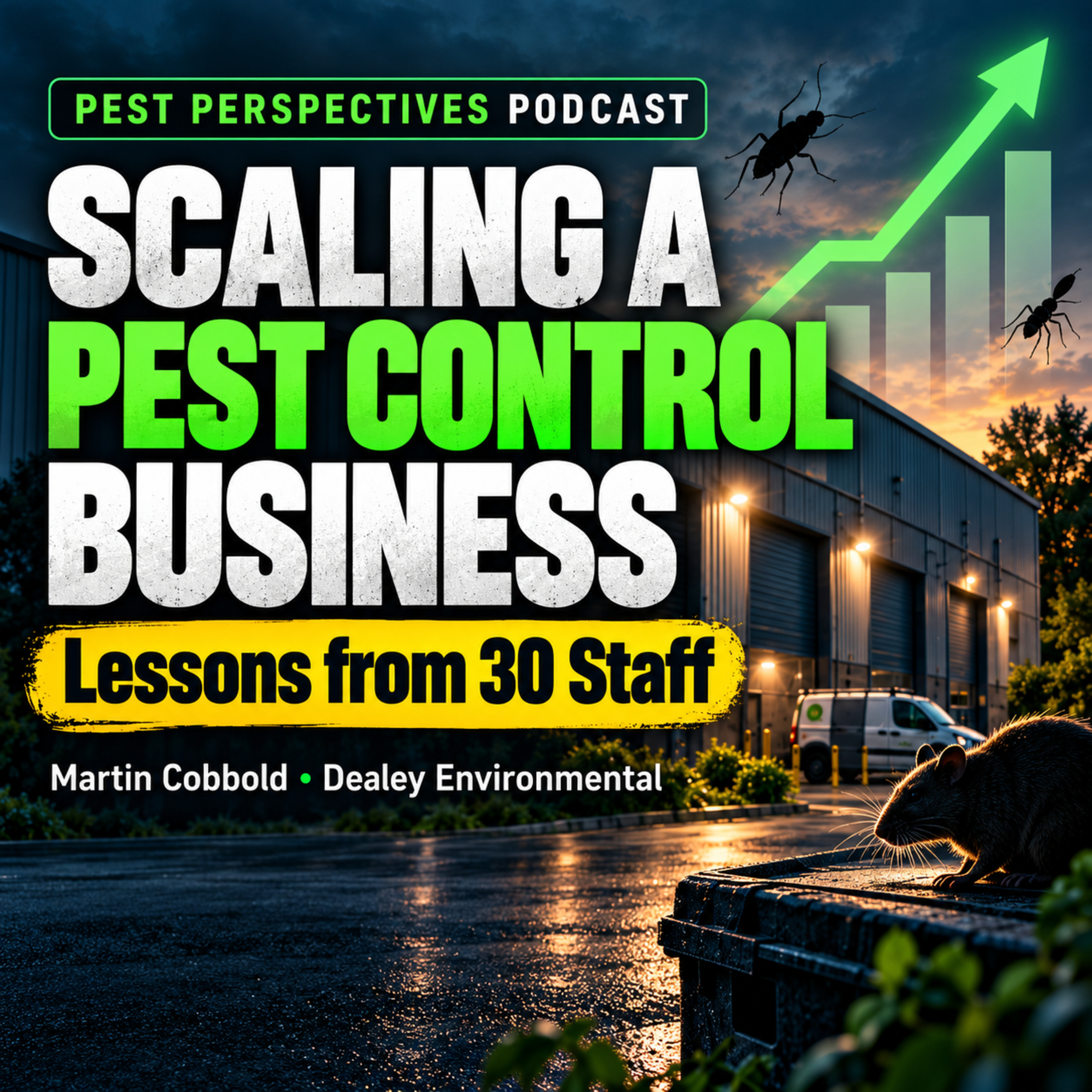
078:Pest Control Fumigation: Bed Bugs, Grain Stores & Insect Resistance | Martin Cobbold
In this episode
Pest Control Fumigation: Bed Bugs, Grain Stores & Insect Resistance | Martin CobboldMartin Cobbold, CEO of Dealey Environmental, joins Shaun to demystify fumigation - one of the most specialist and least understood corners of pest control.
They cover what fumigation actually involves versus fogging, the qualification pathway to become licensed, and stories from the field including gassing aircraft for bed bugs, red poultry mite in chicken sheds, and the serious safety risks around grain store fumigation. Martin also explains the growing global problem of phosphine and insecticide resistance in stored product insects, why Dealey stepped back from ship fumigation, and shares his take on AI, the ageing pest control workforce, and private equity's growing role in the industry.
A must-listen for anyone curious about the technical, high-stakes side of pest management.
#ADPest Perspectives Podcast is proudly sponsored by Powered Now, helping trade and service businesses manage jobs, quotes, invoices, scheduling and reporting.
https://powerednow.com/
I'm inviting you to try Powered Now - it saves me hours on quotes, invoices, and admin. Use my link to get £50 off: https://www.powerednow.io/refer?code=FAB82F72
Pest Perspectives Podcast is a UK independent pest control podcast hosted by Shaun Muller of Oakham Pest Control Ltd. The show features practical conversations with pest control technicians, business owners, suppliers and industry experts, covering rodent control, drainage investigations, bee removal, bed bugs, wasps, commercial pest management, compliance, business growth and wider pest industry topics.Listen, watch and learn more at:https://www.pestperspectivespodcast.co.uk
Transcribed automatically
Hello and welcome to Pest Perspectives episode, I can't remember, 77 I reckon, or 78 on the two. 78. 78, let's have a look. Yep, 78. And this week we have on Martin Cobbard from Dely Environmental, CEO of Dely Environmental. How are you doing? ah quite high adrenaline um i've just uh had to change location as you know and uh and as people can see i'm pretty grainy because um the wi-fi on this location isn't great so i potentially just cut out no i heard everything just a picture yeah i can hear you can you hear me yeah i can hear you now um it just cuts out for me a little bit i i hope this isn't going to be a um a martin driven car crash we'll see what happens it'll be fine so do you want to tell everyone who you are and what you do with the industry um the pest management industry I know you've got a long list of accolades.
Well, no, what? So my name is Martin Cobbled. I muddled my way through pest control. And we have an amazing business here in Suffolk, which is all based around the success of the technician and everybody developing as incredible people. And yeah, we've got 30 people on the payroll now. It's pretty good times. it's pretty high octane everybody's enjoying themselves and we've got some good high morale I started in pest control because it's what my dad did I'm at my dad's house at the moment which is why there's so much weird stuff about here there's a gin trap just there if you hadn't recognised that the rest of it is all milling equipment It's not torture chamber then it's it's got that that vague feel about it which is probably why I like this room so much I don't know I don't do that in my past times don't just yeah don't get the wrong impression so yeah I started after doing a very very relevant degree in in art history which gave me full Ponce credentials and now I run a pest control business I've been doing for the last 20 years or so so it's been really good fun, really good while That's good to hear that is Did you catch any of that?
Yeah, I catched all of it apart from the last second probably it said you got a maths and science degree art and science degree then you run a pest control company you got it yeah which yeah lines it cultured me yeah um so uh yeah still still do a fair amount of poncing about but um it's all within the pest control world now oh nice thanks thanks jason for popping in mate cheers for that um how did you start daily environmental was it i didn't yeah my dad did well no i my dad didn't either um it was started by a guy called dr deely that's why it's called deely environmental um so yeah dr deely was an absolute uh bonkers dude um yeah he uh came out of the second world war having been a submariner and joined ICI to make pesticides as an entomologist.
He got his entomology doctorate before the war and then after the war he got his second entomology doctorate so he was a pretty switched on guy. Knew an awful lot about stored products, insects, knew an awful lot about post-harvest loss. My dad was a farmer initially when he first met Dealey and then he was a grain trader eventually when he last met Dealey and Dealey was selling his business and said how about it which was pretty cool. So yeah dad ran it for what probably the same length of time I've been running it now with just him and one other dude and then when I took it on there it was me and a self-employed dude called Bernard who taught me an awful lot and it was remarkable the sort of high level sites we did even though we were just two people and I really got a really got a taste for the complexity of it and yeah it's not been a it's not been an easy ride to to grow it started off at a pace doing as many sales as I could and ended up, Bernard retired, well, retired, self-employed, so he didn't really retire, but you know what I mean?
He said no more, thank you very much. And I grew it to the point where I could employ two people. Turns out that running a business, you actually have to learn how to run a business. Who knew? And so in layman's terms, Sean, I fucked it up. I was a bad boss. Yay. yeah yeah so i it bewildered me that people didn't think in the same way as me it bewildered me that people didn't do the same level of work and you know i was in my early 20s and um i just sucked at being a boss just didn't understand people at all it's probably because obviously if you run in a business the people working for you don't think like you so they're not going to think i'm going to keep working i'm going to keep working it's a work day at least just people that i knew people from the village you know I mean um I mean it's Suffolk a lot of people you know a lot of people because uh um you know it's a small a small community um and and yeah it's just people that people that I knew come and work for me it'd be great we'll have a great time um and uh yeah turns out that yeah if I used to lose my temper a lot as well like um I found the the stress completely unmanageable um and I didn't know it was unmanageable I just thought oh this is stressful I'm the boss I can I can do some effing and jeffing and put people in their place and they what an idiot um so the the um those two those two left and I thought I better start getting serious about learning how to uh how to be a boss how to run a business properly and um and that since then
has been the most rewarding journey you can imagine um it's been horrible it's been painful and I didn't make as much money between zero and seven employees than I did when I first started. So it was very much a delayed gratification type thing. But yeah, now sort of getting to grips with it, leveling up a little bit, going beyond 27 employees is another level. So everything breaks at 27, as they say. And yeah, everything broke and we're starting again. we're 30 which is it's kind of cool i like the level of honesty you're like i've fucked up you know i've learned along the way because yeah a lot of people when they say you don't a lot of them a lot of people generally won't say well i messed up on the way i did this i did that but you're completely you know i'm it's a learning process isn't it obviously how you've scaled up you know how i'm all saying is in business a lot of people will sugarcoat it and won't mention i made these mistakes i did that i was a bit crap at the start they're like they like the story all it's all amazing it is no yeah and it never is um and it's it's all lies um and the and and that feeds into that that horrible thing where um uh people want the view but they don't want to climb up the mountain do you know what i mean and so they're just just all that does is feed into envy i'm here to say it's actually horrible um i had a great quote uh last year from a guy called alex hormosey who is um yeah i watch his stuff yeah obviously on steroids right so he's this big bulky man with a big beard and huge hair and um uh he's he says something along the lines of the most successful people in business aren't the ones who do the best in business they're the one
the most successful people in business are the ones that can put up with pain for the longest and i found that quite reassuring oh yeah the man's got a 250 million dollar revenue portfolio per year he's doing all right i know yeah you gotta listen to him um so yeah you gotta you gotta put up with that discomfort if you if you're going to grow but bringing it back to pest control you've you've you've got two kinds of pest controllers in my eyes you've got the chest puffers and there are a lot i nick that uh phrase from and she lives very close to you she's a fantastic fumigator in the in the midlands you're on about angela angela that runs where are you you should have her on she was watching where are you say hello if you know you should have her on because she talks so well like she's uh absolutely fantastic person just a great human being and sounds funny like yourself oh now i have to get her on i'll say well martin said come on there you go yeah yeah 100 um and uh and yeah uh she called them chest puffers and i was like oh i know exactly what you mean and it's people who were just tremendously proud and tremendously ego driven and no one's ever been better than me chest puff chest puff and then you get the other
kind of pest controller who realizes that pests can embarrass you horrendously from do it doing something completely unexpected and it makes you look like a bona fide tit and it's uh that's just part of that's just part of the job it's just part of the journey you can never have like a 100 certainty um because yeah you're setting yourself up for a fool and at that point you either grow a bit of humility or you turn into a chest puffer and start blaming everyone else so i i think you You've got to be honest and you've got to say that I can be awful sometimes.
I can have some really bad ideas. But we'll reset, we'll learn, we'll go for it. It's good to hear it is because, you know, obviously they all say, you know, it was amazing to start, to start to finish. and it's good it's good to hear that you're realistic and you actually tell the story i'm not on social media anymore but i loved your your feed because it was um it was very honest and it was very real and it had pictures of you just being to the gym want to lose lose a load of weight and it was you sweating through a t-shirt and just it's just like yeah i like this guy this guy this guy um knows what it's about and knows what self-improvement is all about let's let's uh let's roll with this guy so i was delighted to meet you at pestex i have to say oh yeah because i was like i think i just finished looking around or whatever i came out and you know i was looking i was like he came straight up to me shut me out you're not sure so having in mind we'd never spoke you know you know before i was like i felt i felt like a bloody celebrity i was yeah mate no it's coming close isn't it no not everyone has a podcast well no but you know i do it to help the industry it's like a lot of the stuff that's said is from other people but if someone can learn a little bit and it helps doesn't it at the end of the day uh podcasts have is massively changed it's obviously the beauties and beasties that are
weekly you've also been on that before i've been on that i co-hosted it once they they asked me this is classic they asked me like two hours to go can you co-host this all right i was distinctly underprepared um but it was there's other podcasts i think kill germs got one and other ones but i'm on about the ones that are live and weekly there's only two in the uk that are like that no one really listens to corporate corporate podcasts anyway don't they i mean like maybe i've listened to a bbc podcast yeah i used to like back when podcasts were young i listened to um melvin bragg what the hell is that program called the in our time um but other than that do people really listen to corporate podcasts i don't know i've no i've no idea but uh this podcast is all right and music basically does as far as i know you know six thousand something downloads in or plays this has got that's not every that's not every episode that's like overall but it's not 78 episodes dude that's consistency that's awesome I like it I have missed a couple of weeks here and there but it happens it does have you ever gone back and watched the first few that you've done I need to really because I can watch myself now
I've used to my voice but a lot of people can't listen to themselves they can't but my podcast thing as i didn't start off because i think sean mooney said it once on the podcast he says i bloody wish he says the way sean muller started his podcast off i wish ours was as good as theirs because they started on facebook live didn't they and it used to go wrong a lot and they didn't have all this so he says i bloody wish we could have done that he does and then he said don't go back and look at the old ones.
But everyone does, if you say that. I found out some of my old episodes, you know. Number two is nearly one of the highest-ranked podcasts. It literally, numbers are massive. And the old stuff, too. Who was it? Who was your guest on, too? That was Kieran Bewes from Green Rock Pest Control. That was. I've also had Mark Porter on, Mark Porter from Porter's Pest Control. That was a popular one. I don't know if you know of him or know him. I've seen some bed bug videos. He's the bed bug guy, isn't he?
He does bed bugs as well. Yeah, he does. Oh, sorry. Did I just pigeonhole Mark? Sorry, Mark. No, no, no. His viral content has all been bed bugs. He has gone viral with bed bugs, to be fair. But no, Terry Ashley. Hello, Terry. Hi, Terry. um so right obviously i wanted to talk about fumigation i know not all i know nothing about it obviously i do know that the thing i know is the fact that to actually be qualified this was probably wrong you'll tell me i'm wrong but it takes a lot of persistence you've got to do qualification you've got to spend time under that watch of people and have stuff signed off over a long period so i can imagine that a lot of people get fed up and quit in the end and i bet you have a lot of that do you do you want to explain how it works to get qualified in fumigation because it's it's not like pest control it's a lot harder you want to start with the qualifications is that is that where we're going all right um so you you do your theory which is unit it's a the whole thing is is a level three um qualification so so the level three three sorry i turned it to jonathan ross just for a second um the level three qualification just means you do a bit of coursework okay so that's that's it's it's very much like a driving test as you do your theory and then you do your practical um and the practical bit is the coursework bit um So yeah, it starts off with an exam.
Exam's quite difficult. It's a three-hour affair. But yeah, if you take one of the amazing BPCA courses, then it stands you in really good stead. And yeah, we put people through that quite regularly now, which is quite nice. and I can't think that we've had a failure on that first bit. We've had failures on the second bit and that's where it steps up a little bit. So you have your coursework and because we're a bloody wonderful company, I've just taken the coursework out of the hands of people that don't like being in front of a computer.
They don't like doing written down, this is what I mean type stuff. we're working all through our mobile workforce management system now that I won't mention because of your sponsor you can mention other softwares you can we use big change so we work all through big change now so I've set up a load of worksheets that basically creates them a portfolio and it's got a place to take pictures and signing off from your mentor and all of that sort of stuff. So, yeah, I'm having a fight at the moment with my managing director.
She reckons we can get people through the whole shebang in six weeks. And she's the operationalizer.
It's quite dangerous. Has she done it in six weeks? Have you asked her to do it in six weeks yet? You want to say you prove it? That's a good idea. That's a good idea. All right let see if you can do it in six weeks She do it in two She exactly the same as me If you give someone an expectation it like fuck you I going to smash this Just do it in six weeks she do it in two she she exactly the same as me if you if you give if you give someone an expectation it like fuck you i gonna smash this just do it out of spite he's swearing someone sure why did he say that oh sorry um yeah so your coursework part is is just that you're just making a record of the things that you've done but it's quite it's quite prescriptive in what what sort of what sort of things you have to prove um and then after you've got your your portfolio done that gets marked um and then the examiner comes to your place of work portfolio in hand um and and let's talk through it and then you have a sit down oral exam that you're not meant to call oral exams now because of the sexual implications i'm sure they call them something else it's called it's called like an in in vivo or something like that um and when i a viva i can't remember um but it has a it has a new name um yeah just just like you're not meant to say turkey it has to be written turkey yeah i imagine a lot of that is to go through it so it's like so you can they can tell you've done
the work and someone's not wrote it out for you yeah and i used to be an examiner and there were a few of those there was definitely one where his dad had just done everything and when we we did the exam online and we're doing it face-to-face like you and me are doing now um and I had his portfolio in hand and his dad was there while he was doing it I was like we can't do this we kind of just get out dude get out he was probably talking in his ear um so yeah it's um it's pretty tricky to get into i i think six months stephanie thinks six weeks the truth is probably somewhere in the middle um yeah yeah i like it you make the headlines for that our training process is six weeks yeah yeah yeah um so what is fumigation should we talk about that there might be some people listening going what you see i i hear it a lot right i don't know if you've ever heard this term someone's going to one shot a loft right i'm not saying everyone does it but i hear a lot of the old school old boys i fumigate your loft it's literally just a you you know the fogger shot yeah and i hear a lot of the old boys say fumigation it's not a fumigation is it no it's just it's just a urlb fogger that's it well how nerdy do you want to get because
basically with fumigants you're getting inside insects it's that the particles are that small you're working on a molecular level so you get inside insects whereas with everything else you get on the outside and all the killing is done outwards in rather than inwards out so yeah fumigation is using gases and it's getting things to soak in gas so you've got to make sure that your gas doesn't go anywhere you've got to make sure that you've sealed it in somehow however that looks and so you know that the greatest visual um you know something that everyone recognizes um is um you know when they tent over houses for termites in america you know they've got the gas in there and they're making sure it stays there so they've got a big old propylene tent over the top of it um so that's fumigation and you can do any any kind of container that you can sheet over or make gas tight in some way.
It's perfectly possible to fill that thing with gas and kill everything inside. Okay. So if termites ever come here, your firm would be well set up to do it. We got an inquiry. We got an inquiry last month for termites. Yeah, it was so cool. It was so much fun. It was a really local pest control company. um really nice guy called nigel and um and he said i've got this customer and they import wood products and uh and yeah they've imported a load of termites what we're gonna do um it was it was awesome and uh and yeah we went through so many different avenues of control and then um worked out a way with him that he could just do himself not it wasn't even fumigation in the end um and so was just one of those stories which was like we we networked we did it through um the bbca networking tools um we met up came up with an incredible really cheap really um effective solution for the customer and it was a win-win-win-win type thing um the only win we got out of it made no money it was just i met a nice person and had a lot of fun that's good that's that's good that is because at first you were like, nah, nah, it ain't termites.
No, no, no, because you get all sorts of cool things being imported. We had a pet scorpion in the office for a long time because we'd been asked to fumigate a shipping container that had come in, and no one was quite sure where it had come from because they started unloading it, and we were like, okay, so what was the origin country? And then I was like, oh, we don't know. It could be Greece. It could be Egypt. It could be somewhere else entirely. So we weren't sure what kind of scorpions we were looking for.
But the pest techs turned up. Bob from Belper is another wonderful technician. He turned up and started unloading this container and pulled out the sum total of one scorpion and looked at it. And it was so beautiful that he thought, I can't kill this. And so he put it in a sandwich container, brought it back to the office, and we kept it in a lovely vivarium. And we weren't quite sure what sort of scorpion it was. So it had like half wet, half dry in the vivarium. It's called Bernard, and it's alive and well living at one of our falconer's houses because she loves scorpions.
And I get these cool videos of her shining a UV torch on her. Have you ever seen scorpions in UV? They like glow bright turquoise. it's really really cool i see i've seen something on america where they go with torches and they find yeah they run in arizona i've seen videos i have it's it's wonderful those um places in the desert um the nevada desert where you you pull over on a lay-by and they've got big signs up every every two foot because they're americans and everyone's you know a little bit self-important there every two foot there's a sign that says don't go any further than this point there are scorpions right here and you just think this is so cool and so yeah people do go out in wellington boots and uh and shine uv torches and wherever it glows oh scorpions there and they can go and have a look they do it's um i say i see videos online that's all i have um so what what do you now obviously fumigation there's a big area of pests you can do do you do no right obviously bed bugs however what do you ever get jobs because i know you do aeroplanes as well yeah you get bed bugs on aeroplanes yeah do you do the job do you do you fumigate planes for for bed bugs sometimes yeah you do okay same problems as everyone else bed bugs are getting really hardcore now so when when we do bed bugs we actually double dose compared to a lot of the
other insects on aeroplanes and this is using hydrogen cyanide so it's it's not it's not a it's not a gas to mess about with and you don't go oh let's double the dose just like that it's you know some serious considerations gone into it and it gets yeah raised dosage and um and length time um if we can get if we get really geeky i can tell you about harbour's rule which is is um part of fumigation but um people would probably turn off extremely extremely quickly um and yeah the first bedbugs job that i saw on an airplane was on i can't say the name but it was on a large uh boeing um and it would it was in first class quite pleasingly um and yeah they They'd stripped the seat off completely and just wrapped it up in cellophane to stop anyone sitting there.
But before that, no doubt, there was some snoozing first class passengers being eaten to death as they digested their lobster and champagne. I would have thought so. But the thing is, the thing that made me think there is because obviously there's no resistance to normal insecticides you spray. But you're using freaking gases. You shouldn't have to go hard. Yeah, so there are resistance mechanisms for all gases now, even carbon dioxide, which is a physical gas. So, yeah, it's because it's the same as anything else.
You're adding selection pressure into a population and you're killing all of the ones that die. that makes any sense got that kind of the wrong way around um the ones that survive all breed and so you know it's the same selection pressure as anywhere else in evolution and we're just speeding it up pressing class forward it's all good so when you do obviously airplanes do you does the air company actually hand the rights over to you for that time period that's never been discussed no it's no we don't own that airplane we're responsible for it i don't mean i just mean that first X amount of hours it's been released for you to do this.
Yes, yeah, and then we have to release it back to them. There's two handovers, yeah. Do you tent it? No, yeah. No, well, believe it or not, aeroplanes are gas tight. Oh, yeah, sorry. Yes, they are. Sorry. It's so you don't get sucked out of the windows, which apparently is happening more and more these days. It would be easy that somebody just got sucked out of the window, if I'm right. I heard that from a family member since we were drinking somebody apparently opened a door oh okay I might be wrong that's not advised no no it's not one of the first inquiries that we got for airplanes was a military one and they said they had a history of rats on board their aircraft.
Rats get off the aircraft as you'd expect. They just got off the wheels. It's just bad pest control in whatever airport, whatever hangar they're in. And yeah, they said that their solution previously to get this rat off of their airplane was to go as high as possible and open the cargo doors. Wow. So pilot was strapped in. Everything's fine. Just open the doors, lads. and yeah there was no more rat whether it was from decompression or whether it just flew out I've absolutely no idea but they said they wouldn't do it again because it was a fairly risky business so prefer a bit of gassing So when you've obviously gassed the airplane how long are you looking at before it's safe for people to actually go back on and have flights etc Do we mean safe legally or do we mean safe for us?
Because we've got higher standards than what the legal limit is. So to get it down to the legal limit, you're talking like four hours. It's really, really quick. But we tend to sit with them for like 12. I don't tell many people about the four hour thing. We're talking in amongst pest controllers here. I'd never put that in any marketing material or anything like that. But yeah, you can get it to degas really quickly. the problem that you have is sorption so you get the gases are quite sticky and they stick to things like fabrics so you get a lot of gas coming out of carpets and cushions and all that sort of stuff for a while after the fumigation is actually finished and then you get it down to that legal limit and then you go a little bit past that and yeah we get to zero near as damn it before we hand it back okay no i just thought i'd ask because it's it's interesting it is yeah 12 hours something like that is um normally beginning to end of a aircraft fumigation okay so i imagine with fumigations you i'd imagine you do a lot of um mills um because andrea did mention something once you are whatsapp they're saying you're on yeah i can't remember where she said it was obviously you can't mention names but there was a really successful program you've done recently at the mill you did work really well um and you was that be one you completely tent up completely again no we don't use tents at all we so so if you've got a no if you if you've got a building like your website has got a tent on it on one of the buildings whereabouts wait a minute go on you have a look do the environmental I'm sure I've seen it on there
I might be wrong wait wait wait tell me where you're looking and I'll tell you what it is oh it's not I've seen must be someone else then find out more no i've got it wrong sorry i know it wasn't you then i was so much less visually striking unfortunately i'd love a big circus tent but no it's all right here right here you've got a blog you've got a blog but it might why blue boom works when other pest control treatments fail it's a blog and there's an entire building intented over show me show me uh someone's gonna be in trouble hold on where are we where are we let's see where are you right and hey that's a chicken shit that's not a tent oh you've seen it what is it then?
a sheeting, that is just polythene sheeting, it's not a tent so can you see where those weights are? can you see where those weights are along the joins? oh yeah so it's just strips of sheeting how stupid I am, sorry, there we go oh no, it's okay so yeah, those red things are sand snakes it's a chicken shed, so it's not particularly tall and that'll be done for red poultry mite red poultry mite are cool do you want to talk about them? Yeah, you can, though. Do you keep chickens? No. So, yeah, anyone who has chickens, they end up with red pulchumite at some point.
But, yeah, absolute brutes. They get stuck into all of the cracks in the crevices, and they suck the blood out of chickens' legs, which is rather delightful. And, yeah, like a lot of mite, they go hypopal, which is that kind of short circuit to the life cycle where they've got like a sort of a proactive pupil stage. Some of these mite species are absolutely incredible, the way they react to adverse conditions. So, you know, mites are older than dinosaurs, right? And so they've outlasted ice ages, they've outlasted huge droughts, all of that sort of stuff.
And because mite are mostly water, you know, you squish them and they just burst like a gross blister. and yeah to be able to survive through these adverse periods if there's a massive drought they just go to sleep and they call that hypopus but the cool thing is is this is another resistance story is it doesn't have to be lack of water that makes them go hypopal it can be adding a pyrethroid or something like that and they go oh don't like this and then turn into this sort of weird pupa so yeah and once all of the pyrethroid has gone after the six weeks the manufacturers claim and no one believes then they'll come back out again yeah so that obviously you know obviously the manufacturers and obviously the experts don't exactly agree then so it's it's how it well if you if you were running a chemicals company um and you wanted this chemical to be really good because you've really you've really spent loads of money in researching it and releasing it um you're you're going to ask them to test it more than once right yeah and if if you test it 12 times you're going to come out with the best test results it's just you know it's human nature um you're not going to go well on average it's actually four weeks um you'll just go yeah six weeks this test works six weeks so it is technically feasibly six weeks um and anyone
would do that so yeah and you know as long as it does the job who gives a toss just as long as you're not um hanging your your technical reputation on this is going to work for six weeks because we all know that other things get involved with uv light and temperature and humidity and all of these things in breaking down the um breaking down the whatever active you using so yeah don hang you out on six weeks just because it says it on the label You know I would probably Label is raw! Not that bit.
Yeah, there you go. Yeah, exactly. So, yeah, one of the cool things that I've been getting into is doing degree day calculations. Have you ever seen these? No. Lots of fun when you get into insects. So if you're using insecticides, then you can get any old research paper. So we're old school and we've got an old Excel spreadsheet now. But if I was starting this again, then I would start with chat GPT or clawed or deep search or whatever. And I would go, what are the degree days above a certain threshold for this insect?
and you can get this sort of idea of when the eggs are laid today, when they're going to hatch out. And so if you've got something that is a nerve agent, like any of our sprays, you're not going to be killing any eggs because you haven't got much of a nervous system to have a go at there. You're only going to be killing the larvae and the adults, right? And so the cool thing to do there is to say, all right, we're going to get the adults and the larvae now and then we'll come back and do another treatment which is second money it's that's that's good good for business but it's also good for the customer because you know that the eggs that you've missed with your your residual is you're going to go back and actually um deal with deal with the eggs that are then hatching out and it's all defined by temperature um so you have this um incredible sliding scale of um of development days um based and that's why it's called a degree day formulation um and this is why when you look at some of the insect fact cards you get unbelievable variation in life cycles um so you get something like an indian meal moth and it says well this this can develop between six weeks and 52 weeks and you're like where does this come from i mean that's all to do with the all to do with the temperature that won't be very good an exam what do you what would you put you know there's going to be there's going to be a right answer there you know i'm taking something that's particularly extreme oh no um yeah they'll be doing everything at room temperature and pressure i'm sure yeah
no no no you're right there we've obviously um one thing that i have heard a lot about is not your company i'm on about in general in the world of fumigation there's been a lot of depths infumigation with people actually in the grain stores when they're doing it walking on grain and dying due to getting something or something does that happen is that why safety is paramount in infumigation obviously yeah yeah so we we lose about two a month doing that that's it's not a laughing matter sean um so this is people it's familiarity breeds contempt it's yes um never a truer word was spoken and this is why you always need your god i'm a norse five steps to risk assessment you always need that step five the the review bit because you've got to continually update these things you've got to have somebody get a fresh pair of eyes on it and all that sort of thing so the people dying getting sucked into grain bins it doesn't tend to be doesn't tend to be fumigators i've not heard of a fumigator dying that way um But I've heard of a lot of farmers dying that way, like far too many, young, old, doesn't matter.
But the one most recently that I can think of was only just a few miles down the road. And he was in his 70s going into a grain bin while it was being emptied. And you think, dude, you should know better. And it's sad. It's a tragedy. But don't go into a grain bin when your machinery is moving. You just, yeah. The way the grain silos empty is they go from the top down, right? So it's like an hourglass. can see the grains of sand going down first that are at the top and and a grain bin is no different you know you you start pulling it out the bottom and it sort of folds in on itself and empties out and of course that makes like a quick sound type funnel and it sucks and it's not the you know it's it's not the actual being buried alive suffocation type thing that gets you it's the actual pressure of the grain on your chest that you can't draw breath on there was a guy in Norfolk maybe 8-9 years ago who got sucked into a grain bin and they started to dig him out they started to panic he kept going down and he kept going down they ended up giving him a hose pipe so that he could breathe through it last thing to go was his hand and he was doing the old Terminator you know I'm okay I'm okay and yeah he just stopped breathing after that so even though he had a hose pipe to breathe through so yeah it sucks but when most of the accidents happen with actual fumigation is in shipping things get a little bit loosey-goosey when you get into international waters and this to my knowledge hasn't happened going from the UK but we've had a few coming to the UK where the fumigation has been done in a less strict country
and they've had sailors being killed on the way over that's yeah do you do any ships do you just work like that as well we've stopped doing ships we stopped doing ships maybe six years ago something like that um because it's so bloody stressful i can imagine the red tape would be unreal wouldn't it it really would be because no no no No, it's so loose. It's unbelievable. So, yeah, you've got 16 pages of handover documents to do, and they're really detailed and they're really good, and they've got instructions for, you know, this is the fumigant, this is how to handle a problem, here's your safety gear, here's your measurement gear, and there's training in the safety gear, there's training in the measurement gear.
But, you know, as well as I do, Sean, what it actually is, is somebody going next page rubber stamp next page rubber stamp no one actually reads it um so uh so yeah you've got generally and this is broad stereotypes an angry russian captain an angry russian mate who smells of booze and then you've got a load of filipino guys who do all the work and um it certainly comes across like they're not being treated quite as well as they should be. So yeah, we've got massive respect for the people that do ships because they've, they've got to, as soon as you walk onto that ship, you're obviously, you're, you're off England.
You're then on the, in the country, the ship, the ship's flag is flying. You're dealing with people of all different nationalities and you've got to somehow get them to be safe. And then you're doing a fumigation, which is forefoot maybe from somebody's head while they're sleeping. So, the guys that do ship humigation hats off to them but for us it was um operationally stressful because uh ships are kind of uh we've got a big job for you and we want you here tomorrow and we want it and we want you to do it cheap and so for us strategically not not for us no definitely not no um obviously yeah because obviously that's a business decision you made not to do no more obviously it's for the obviously it sounds to me like it was too much hassle for not enough money basically yeah yeah well i mean you you tended to have ones that made not enough money and then ones that went perfectly and they were bloody wonderful um and and you made a good a good margin on them but the mixed bag was too mixed for me and the juice wasn't worth the squeeze just on the amount of stress that it put on the ops team um so you know we've we've got all this work to do we've got the week filled and then all of a sudden for two people the whole week is thrown out because how you've got one ship to do.
And yeah, they come in big tonnages. It's like 20,000 tons, 40,000 tons. And it feels good when you're doing it, but it's a long time away from home and it's operationally just not for us. The team at the moment are very interested and are starting to do ships again. And I'm a little resistant because it is so stressful. But yeah, there's quite a lot of interest. And no doubt we'll be doing it again next time we meet, Sean. Is Angela one of these people asking to do a ship then? I don't think so.
No, I've not had that chat with her. No, it tends to be the young bucks. Does it? Yes. And they just want, you know, big machines and big jobs and lots of, you know, lots of cool experiences. you know some of these ships that have been done in the past they've had the fumigate to go with them and they're off to puerto rico or something like that and some of them you have to get on when they're at mouse anchor so you have to go out in a little speedboat and then you have to get on via a via a rope ladder so it's kind of an adventure do you know what i mean yeah that's probably why the young ones want it yeah that's probably yeah yeah no no not for me no not me so so to you are you still if you ever I'd say obviously you're the CEO do you ever get hands on and do any jobs anymore yeah yeah yeah yeah which was lovely to be honest I had such a nice when I was smacking a container door with a sledgehammer and we had a health and safety rep turn up and he was the health and safety manager for for one of our and i'd never met him and uh one of the techs russell um spoke to him and he said oh yeah this is martin he's ceo and i turned around covered in shit and with a sledgehammer in my hands like this is what a ceo looks like and uh and russell god bless him said this is a ceo that doesn't mind getting his hands dirty and i i was i was really touched by that because i felt like a little bit embarrassed that i was
like a fake ceo um but so yeah no it it does it it does still call for it every so often that i get out and join in with the lads we had um uh quite a staffing shortage and um uh too much work uh at the end of last year um and i hit the road for maybe like four months something like that um and and it was cool i i um being a um a productivity wiener i uh i i i redid my morning routine uh to fit my uh my on the road life as opposed to my going to the office life so uh yeah so with that though did a lot of customers know who you were or did you just pretend you were a normal worker you're like yeah it was a mix it was a mix depending on the customer yeah so so i turn up and and like i've known them for for 20 years or more yeah and um and yeah you turn up you have a laugh and it's it's good times but yeah if they don't know me i'm not going to turn up on site and take over um you know the the text this is this is their relationship with this customer i'm not going to get in the way of that no you're right there it's um it's good to hear that you will get hands on if you need it which is good it is yeah yeah no i mean it's it's it's the wrong thing to do for any business leader to to get get involved and and start you know putting
on the the superman pants but every so often needs must you know to be fair you've got that mentality where it's like you wouldn't ask anyone to do something you wouldn't do yeah like in wwe when they used to say you know whatever his name is i he would try anything you know so they can you know i can't remember what his name is the girl wwe vincent man uh that sounds dangerous he would literally try anything and then he'd show them look there you go i've done it you can do it is he still alive he is actually he doesn't own wwe he sold it off oh did it oh okay yeah i'm not i'm not a wrestling man i um i watch it probably once a year wrestlemania so yeah i i went out with the days of macho man randy savage that's uh that's the last time i would have watched WWE yeah and in those days there was WCW as well and WWE was called WWF which is now the World Wildlife Foundation not wrestling they went to court you know that all went to court and WWE fought them obviously the wildlife people obviously won because they've been around longer they won it easily they're so litigious aren't they yeah but um but yeah it's um if someone was wanting to get into fumigation how would you recommend they get into it say obviously as a if you want to work for somebody is it much harder if you've
got your own business to start doing for me fumigation i imagine it if you've not got unlike you know you know with the qualifications do you have to redo them every so many years like a ticket you know lifetime things it's a lifetime okay i just wondered that was all okay yeah um that that's so this used to be really really dicey um and bpca god bless them have have really really cleaned it up since the last 10 years, 2016 I think it all changed. 2014 is when it started to change because who the hell was it?
CRD I think, Chemicals Regulation Division said all right let's look at your exams all right who audits these and RSPH was like well I don't know and they had a a load of exams that had to be post audited and then like a little conversion refresher go on um but yeah since then it's been it's been pretty watertight as an examination goes if i all right sorry to answer your question properly um uh so it can go two ways it can be really easy or you can do it yourself um so if i were starting again i would network really well um i would get um some customers interested and I would look to employ somebody who's already qualified and that and then I would do my I would do my portfolio with my employee that that would be the way I'd do it if you're doing it solo if you're an owner operator and you don't want to employ anyone well for a start you need you need a second pair of hands to do fumigations but yeah that's by the buy, then you would have to find a company willing to do your training.
And you can do this several ways. I mean, whatever happens, that's going to be very, very time intensive. But you can, you know, you can pick up stuff abroad, or you can go and work with a company that's long enough way away from you that you're not going to interfere with each other's business and all that sort of stuff. um we've we trained up at least four um other pest controllers from other companies in in fumigation um and uh yeah it's it's um i can't think of the time oh yeah one one it ended well and it you know the guy was a gentleman about it and it was like all right we've both got our businesses and let's look after each other the rest of the time has always gone really badly so we probably won't do it again.
It's something that I was always like, oh, there's enough market for everybody and we have no problems about losing customers or anything like that. But it turns out that some people just aren't up for going out and finding their own customers and they're just much more interested in yours. That can happen. It can. There you go. I lost you, Sean. I can hear you. just that you froze for a minute i could hear everything you said she went you went into freeze mode but uh yeah that's some good advice there some good advice there on uh fumigation it's uh it's not an area i would want to but it's something i've never had anyone on on the where's he gone i said that and i'm still here there you go there you go i've never had anyone on the on the podcast to talk about fumigation because i'll be honest with you not that many in general i don't think many i don't know the stats but i don't think many pest control firms in the uk do it do they not many no last time i counted which was probably five years ago i think there was 17 companies that did it it's not a lot is it no it not a lot it what you call specialist yes yeah yeah and it a lot of companies like yours you obviously invested in the long haul It a long project isn it Because you got to keep people that want to keep doing the job for you fumigation, keep them interested, incentivized.
But you've also got to get new people. And I imagine you have people that start it and then, I can't be arsed for this anymore. Do you get that a lot or not? Yeah, it's hard on the body. It is hard on the body. I mean, for the first, let's say, six weeks of doing it, you know about it. It's, you know, you're stiff in the morning and you hurt at night. It's you're using odd muscles doing weird stuff. So it's kind of like if you're a runner and then you go and run up some sand dunes. It's a completely different set of muscles that you're using.
so yeah and there's there's there's some pretty gnarly environments that you work in so it takes some it takes some toughness and for people that don't don't want to work hard it's just it's a nightmare job because you're in a team and you're being held accountable so it it can sometimes feel a little bit a little bit military if you know what I mean I will be but it's all safety in tip safety is paramount and it is yeah yeah so yeah so I can that round it nicely have we missed anything to do with fumigation you think to do a fumigation yeah I know this I just made the brief version obviously so yeah that is that is your whistle stop introduction to fumigation.
Hopefully people know a little bit more about it now. Yeah, it's cool. I really love it. And you get to do weird stuff in weird places, much like a lot of pest control. But you get out as much as you put in, same as anything in life. And we put in a lot. We're off to Hyderabad in March, which is going to be cool. um and and yeah that's like the the amount of travel for fumigation has been bonkers um so yeah like last year i was in serbia um i've got somebody trying to get us to go out to finland um it it doesn't tend to be you know bermuda i went to i went to trinidad once that was kind of cool um spent spent a week out there doing fumigation stuff um but uh trinidad and tobago is is two islands and tobago is kind of the touristy nice bit and then trinidad is the heavy industry bit and so i spent a week in hot sunshine in uh basically industrial wasteland so wherever you go it does tend to be you're following heavy industry around rather than going to somewhere nice and exotic yeah now i'll tell you one thing i forgot to mention you mentioned in your emails and there's some within fumigation some up and coming challenges ahead yeah yeah yeah yeah so we've got the same challenges as pest controllers i mean you know we're we're deep in the pest control world as well um you know it's half our business um so i i the the thing that i like most about pest control is the consistency and the stability um you know there's an awful lot of an awful lot of work there's no seasonality to it well there is but it's it's not as bad um
and the uh the the resistance problems that the pest control are dealing with it it's amplified a lot in the fumigation world um so most of the stored product insects that we deal with come from subtropical areas and um subcontinent um and uh if you um if you look at some of the fumigation practices in somewhere like india um they're not they're not good um there's been i think something like 40 fumigation companies that were banned by the australian authorities and that were from india and that was just in the last year.
Reverse that. You just said India and Australia. I don't understand. Okay. Oh, so as soon as you do fumigation, you're talking internationally. You're not doing the job internationally, but there's stuff being sent into the country full of bugs all the time. Oh, right. Okay, I get it. I get it. Sorry. So you'll get a shipment of something, let's say coriander, and it'll be fumigated in India and sent over to England. Oh, it's still got bugs in it. Why has it still got bugs in it? Well, we're dealing with Indian bugs here and they're highly, highly resistant to all kinds of insecticide and highly resistant to phosphine gas, which is the main fumigant that we use in the UK.
So yeah, you have to elevate your protocols. There's a lot of research out there now where you have to get to certain levels for a certain period of time. You've got to make sure that those levels stay there to make sure that you've killed the most resistant life stages which is the eggs um and uh and yeah that's where the international element comes in is you're always looking uh upstream in the um the supply chain okay okay no it's interesting that i was like so i see it's on the global scale didn't it it really is and yeah you're cleaning up the mess that is is left by by other fumigators all around the world um in australia they've got the most fantastic stories because we talk about qualifications in australia um you do uh two fumigations under supervision and off you go you're a fumigator um i don't think australia they're quite strict generally they're very strict for quarantine going in and out but not so much they kind of banned glue balls before before the uk did well it's not banned but it's a licensed here but it's they got rid of them first they did australia yeah well they have they got a so the australians have or had a wonderful practice of fumigating lorry trailers, which they called phosphine bombing.
And the way that commodities are traded, they're only checked once, once you've sold them. And if you can get all the adults dead at that point that they're being checked, no one can find things like pupae and eggs. So as long as you can kill all the adults, you're absolutely in clover. So these fumigators used to just throw a load of phosphine pellets, same as your fos toxin pellets onto a trailer and just say to the driver don't stop mate they called it phosphine bombing and it would be under gas for like like maybe four or five hours they're going you know with this these long australian roads um and by the time it gets there all of the adults are dead and uh and yeah they check it yeah that's fine bring it in mate so yeah if you if you want something to create resistance that's your perfect recipe so yeah you've you've got some incredibly resistant species all over the spot and when when you're trading commodities everything is time sensitive and so people are always wanting to like cut back the time and because time is one of the essential essential ingredients in fumigation the time pressure is there just can can we can we release it now can we sell it now come on come on come on and so yeah if you haven't killed everything all you've got is just those those resistant eggs left over um so yes globally it's a massive problem um conferences that i go to it's all the people talk about from all around the world you know what are we going to do about resistance management um and more and more is coming out now around remote monitoring of
fumigations and all that sort of stuff so same sort of solutions apply um and uh and ipm pyramid type stuff you know creating physical um physical barriers rather than um any kind of chemical control is uh that's the same as it is in pest control it's the same solutions for the same problem um it's just magnified to such a degree because there's such bad practices internationally um yeah and we haven't even got on to the other the other big issue which is the demographic problem because you know everybody in pest control is getting so long in the tooth do you know what i mean um they have i mean a lot of it's like i think bpca had a study where was it or study or survey that 50 of the industry is future retire in the next five to ten years is that right something like that yeah yeah yeah so um and and finding people that want to do the job is is tricky um we're in the interzone right now because all of a sudden we'll have we'll have a lot of people to pick from um do you have people talk about ai much on your show yeah yeah yeah you can talk about ai if you want to so i use it i i'm i'm i'm doing a mystic martin thing here where ai is apparently going to replace a lot of jobs and a lot of those jobs are going to be white collar jobs you know
it's going to be people like lawyers people like um accountants um those sorts of uh those sorts of people terry god bless you god bless you we should have a little competition who's who's been working here the longest um uh so yeah it's it's it's something that a business associate of mine calls uh white tabula um there's going to be an awful lot of retraining going on where people are looking for a job to replace their middle management office-based job and they're going to want to retrain into something that is irreplaceable by something like pest control it's true because they reckon that electricians are going to become one of the top jobs they reckon as well they do all the ai and electric and stuff but there's a lot of electricians already but you are right this control could fill that gap for many people retraining you're right they can because you always need pest control won't you yeah that's a problem that's not going away and That's why there's so much private equity money coming into the sector right now.
You know, there's the whole middle of the sector has been hollowed out by people coming in and buying everybody up. And, you know, I'm not a big fan of all that. I think it's bad. I do. But it's not for me to say. That's my personal opinion. I'm not a fan of it. I'm not. I'm not. You know. Good or bad, it's the water that we swim in now, isn't it? Exactly. Terry Ashley says he uses AI every day to write reports. So do I. I use it as well. I'm having trouble with my connection here. I'm sorry about that.
Are you there? You all right? Can you hear me okay? Yeah, yeah, I can hear you fine. Yeah, no, Terry Ashley says he uses AI every day to write reports. I do as a kid. I'm here. You there? Sorry about that. Yeah, yeah, yeah, yeah, yeah. Yeah. Can I say it again? Can you hear me all right? I can hear you fine. Fantastic. I can't see you particularly well, but I can hear you well, yeah. So if I was an investor, you know, and I've got a lot of, I'm sitting on a lot of money, and I need somewhere that is AI-proof and vaguely recession-proof, where am I going to put it?
And, you know, we already saw veterinary surgery. It's taken over by PE. And everybody hates it because now you go in and open your wallet, basically, you know, it feels like a bit of a cartel with insurance. But they're making money, you know. And now it's hard to find an independent vet. I have one. In Oakham. They're independent at the moment. Without any doubt. Yeah. Exactly. But you are right there. You've got an independent vet. Yeah, independent vet. Yeah. No, they've only been open a year or two.
They're like gold dust, dude. well we moved because the other one i found out were owned by conglomerate which i didn't realize but it's kind of they've monopolized it they've monopolized i think their price fix it too so they're all basically nearly the same yeah but uh yeah there's there's definitely you know um some some feel of that commercialization that commoditization around it which which is sad because it's your pets and you love your pets um but it you know it feels like something very similar is going on in pest control that you've got a lot of places that are sort of still branded as the company that they were when they were bought and but the private equity operator is operating them and so you have that sort of independence look but it's actually a much bigger machine that's sitting behind it and and so the the the customer choice certainly gets reduced somewhat but what it does do is do some driving of the economics in our sector which which personally I'm a big fan of.
Everybody can reduce prices and win the work. But what it's much more difficult to do is actually increase skill and then ask the price to come up and meet you, which if this private equity thing continues, that's the trend that it is taking. So personally, I'm a fan of it. And I know there's the downside of the lack of independence and stuff, but I find myself sitting on the other side of the fence to you, Mr. Muller. you'll be like you're just thinking in years to come how much am i going to get from my company one day one day i might do it one day you're like how much will i get that's how you're thinking maybe well no that's not how i think jesus i'm thinking i'm thinking of what we can do over the next five years and i've got a growing business so you know the asset is growing quicker so it I think it would be foolish to get rid of it.
Yeah, I think with your independent vets, this is the same thing that's happening in pest control, is you get a private equity machine touch the business and put something up independent themselves. And so there will always be that natural pushback that there's always that 10% of the market that is owner-operated, you know? That's true. that is it's it's easy to find out who's owned by who very easy it is I look quite regular who is actually independent still I do and it's surprising a lot of firms that you think independent and not but have we lost connection?
hello hello hello right hello hello frozen again so uh good conversation martin are you there
martin
so if you haven't uh follow pest perspectives please follow press perspective on spotify subscribe on youtube and also i'm sure we're back in a second and follow on facebook we are sponsored by powered now a job management software company so after the show there'll be a link for you to click in the description which you can get a trial or there's a deal there is yet to try power now out uh martin has dropped out he's done incredibly well to uh last this long with the connection he's got that's why i dropped the my my end down to a 720p so um if you notice that that's what's happened but it's been a great it's been a great conversation about fumigation and it seems like the kind of person we could have another chat with at some some point it does i'll just wait to see if he comes back i will um yeah so it's uh it's it's very different when you try and talk to yourself on the podcast i don't know how these podcasts do it that uh have podcasts by themselves they do so um hang on he says he's down there I'm coming back I'm coming back I just explained to everyone your connection that you've done very well for that long I've just done all my powers now things follow the podcast and everything
but no thanks for coming on Martin I think it's been great thank you for putting up with my appalling countryside internet connection God bless you Sean I'll have you back on talks about other stuff in the future if you're up for it and have a chat about some other stuff if you want because it seems that there's a lot you could talk about you know your stuff yeah no I mean you pick up bits and bobs in 20 years and you know I've got 20 years more in me so and I've always got an opinion it's not always the right one but we've been through that I think that's fair enough that is I'm going to end the podcast there if you just stay on the line for a minute but thanks everyone Thank you Sean, thank you everyone for sticking with me there and thanks everyone and I'll see you next week hang on, end the stream not leave studio, there we go, thanks everyone
Sponsored by


 Spotify
 Apple Podcasts
 Goodpods
 YouTube
 Amazon Music
 Audible
 Castbox
 Castro
 Deezer
 Moon FM
 Overcast
 Pocket Casts
 Podbean
 Podcast Addict
 Podcast Republic