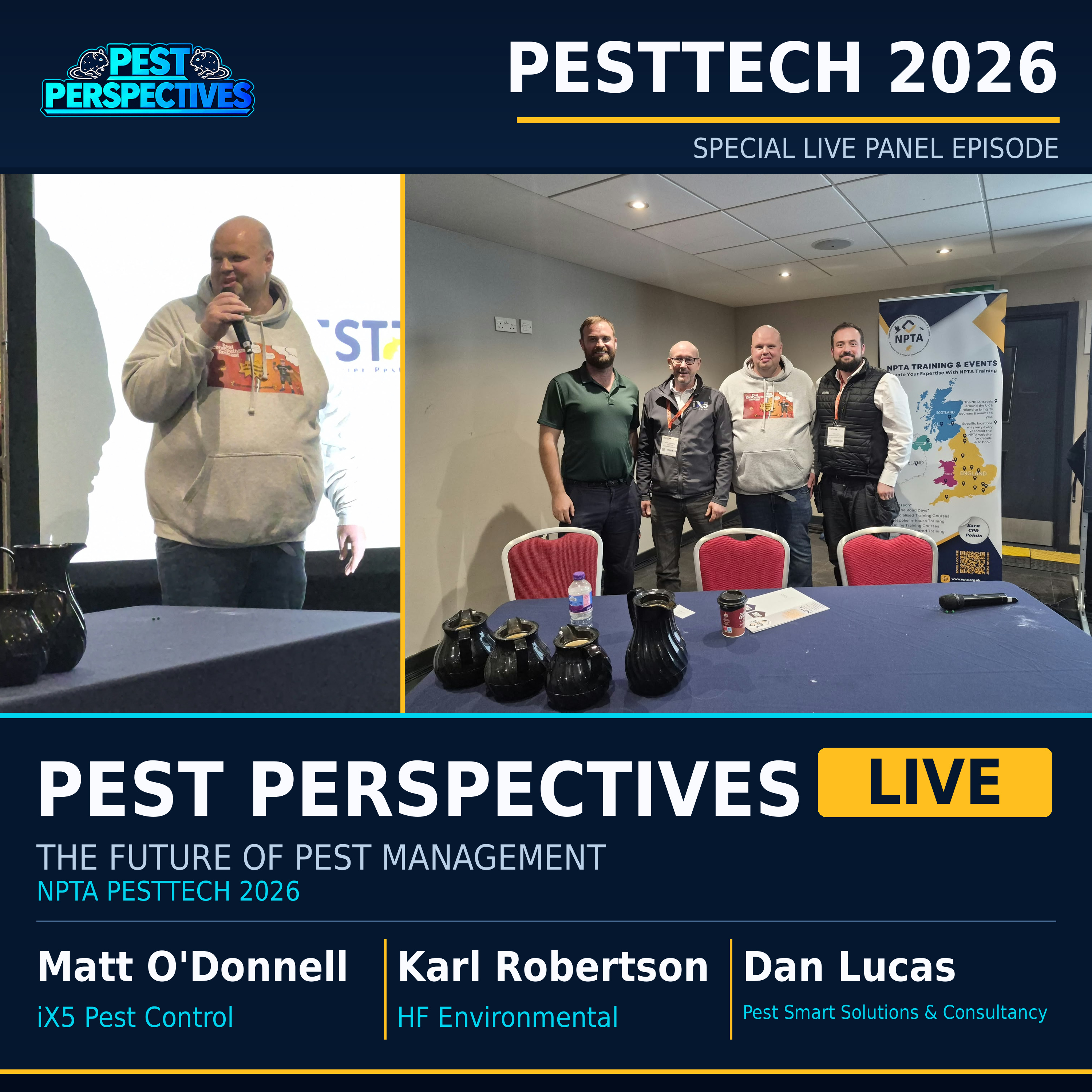
Pest Perspectives LIVE at PestTech 2026 | The Future of Pest Management | Expert Panel Discussion
In this episode
What does the future of pest management look like, and are we doing enough as an industry to move forward?
For the first time, Pest Perspectives Podcast goes LIVE in front of an audience at NPTA PestTech 2026, held at Arena MK in Milton Keynes on 4 November 2026.
Host Shaun Muller is joined by three experienced pest management professionals for an open panel discussion exploring some of the biggest questions, challenges and opportunities facing the UK pest control industry.
Joining the panel:
Matt O'Donnell – Founder and Director of iX5 Pest Control.
Karl Robertson – HF Environmental.
Daniel (Dan) Lucas – Pest Smart Solutions & Consultancy.
Topics explored include:
Public perception of pest control and how the industry is viewed.
Moving towards preventative pest management rather than reactive treatments.
Raising professional standards and customer expectations.
Demonstrating the real value of professional pest management.
How the industry can evolve and improve for the future.
This discussion brings together different experiences and perspectives, encouraging pest professionals to question established approaches and consider where the industry could be heading.
A first for Pest Perspectives! 🎙️
This was Shaun's first experience hosting a live seminar panel, bringing the podcast out from behind the screen and in front of an audience.
It was a fantastic learning experience, complete with a few nerves, valuable feedback and plenty of lessons to take into future live discussions.
A quick note about the recording: 🎥
This discussion was captured on a mobile phone during a busy exhibition, rather than through our usual podcast recording equipment.
As a result, audio quality may vary, some background noise is unavoidable, and not every word from the discussion may be clearly audible.
We've shared what we can from the recording because the conversations and perspectives deserve to be heard.
A huge thank you to Matt, Karl and Daniel for taking part, the National Pest Technicians Association (NPTA) for providing the opportunity, and everyone who joined us for the final seminar of PestTech 2026.
And to everyone who stopped Shaun throughout the day to share their support for Pest Perspectives Podcast, your kind words genuinely mean the world.
Pest Perspectives Podcast brings together professionals from across the pest management industry to share knowledge, challenge ideas and explore different perspectives.
Whether you're a pest control technician, business owner, industry supplier or someone interested in the future of pest management, we hope you enjoy this special live edition.
Different people. Different experiences. Different perspectives.
Proudly supported by:Powered Now – Business management software for tradespeople.Dan Traynor ACA – Periscope CFO.
Transcribed automatically
hello there everyone uh just a quick one i'm gonna thanks to everyone that came and said hello to me at pest tech 2026 in the arena milton keynes it was good to have a chat with everyone that let people let me know they listen to the podcast um it's a great experience doing the seminar live it was something new i've never talked in front of people before in a in a live place so it was quite good but most of all i'd like to thank everyone that came to watch anyone who supports the podcast likes it shares it subscribes follows everything it means the absolute world to me um thanks to the seminar members so i had on matt o'donnell from ix5 pest control shout outs to you done an absolutely great job carl robinson from hf environmental absolutely excellent and dan lucas from pest smart solutions and consultancy it was an absolutely incredible talk apart from the fact to hold my hands up at the start i forgot to mention who people were and um where they were from but that i put that down to nerves it's just one of them things i've learned now so if i ever get any more seminars that would be one thing i will mention straight away i will after this video now you're going to have some clips now i had some clips recorded
so i just wanted to so people could hear them it's not the half an hour podcast but they're all clipped up so i'm going to chuck them all together for you all so um don't moan if it's a bit of context miss but i think most of it is covered but i just wanted to anyone who didn't see the show um so you could get a bit of an insight but yeah so thanks everyone and i'll see you all next week and at pest tech 2027 i will be there helping as always in my mpta capacity so yeah thank you everyone improving is i think it's more about integrated pest management it's about getting the customer educated and getting them buying into what you're trying to do overall on the site by improving hygiene, housekeeping and proofing.
I don't think you can put it down to just something such as proofing, spending the time educating the customer, getting them on board with the treatment plan, making sure that they're sort of acting where they can to help the situation, housekeeping, coming back vegetations, denying foraging rodents potential water sources by repairing driveways and bits and pieces like that. It's all built together and I think to go just down the proofing route is probably just too much of a niche. It's all about the integrated pest management as a whole.
Again, I generally agree with that. I think proofing is absolutely essential and it's something we should all focus on when we're out doing our work. It's getting to the root cause and identifying what the root cause is, the ingress point, and obviously tackling the problem, getting proofing done. but proofing in itself as a standalone thing is probably not going to solve much. Might prevent a bit of activity but it's one of the tools we have. Absolutely essential tool but in a combined toolbox that we have just digging with the problem, solving the problem, stopping it recurring again.
Yeah coming third is obviously the hardest part because the guys are saying some fantastic stuff so pulling something else out of the hat now. Proofing is a really essential part of what we do and I think the point or the question I would say is with the integrated pest management approach, we need to be looking at it as we're environmental and habitual specialists. We're going in there and understanding the habitat that the pest is living in, right? And with that education and that process that we can take the customer through again, we're able to find all of the answers and rather than again coming up with this oh we need to proof that hole and again you'll never have an issue it's understanding that we're dealing with an animal behavior and that one of the behavior isn't going to behave the way that we want it to even though we feel like we've got the correct right answer and i can imagine these people out there that we've gone to a problem and we've gone yeah no problems at all we're going to solve it i've got the answer for you mr customer or mrs customer here we go and then two weeks later they go well i've got mice back and you're going ah other than you would be stunned.
So it's that approach within the journey that you take a customer on, that it's a really essential part. And yes, if there is a proofing identified, let's get that done. But what could then happen? And obviously, the law side of the bird side, and then she wrote in proofing, it was interesting, that bird proofing, yes, solves the issue if you're proofing that loading bay, but where is that issue then going to move to? And it's taking that customer through that journey alongside that as well. Obviously it is only that box or those boxes that will be monitoring.
So if you get rats going into a warehouse five meters away that's not going to be spotted. And that's where it's really important that we don't give up our frequency of visits and things so we're still picking up all the other Amserious stuff as well. Yeah, no, obviously I've tried, well I do these AI heavily with digital reports, it's quite good. I have trialed at digital boxes for Cedenta, there's quite a good trial and it's kind of like it tells you if it's been in the box. I mean I think it's a great tool but as you say there'd be certain parts of the site that get nothing, they may have run over the box.
And also it's an interesting feature, I'm doing a new trial soon for some different digital boxes but I do think there will always be a place for pest control. you can't be replaced by AI, but there's great benefits to using AI. A lot of people still use paper reports. Not many people do anymore, because AI is just so good at using it. But you've got to make sure you need AI to use your voice and don't let it sound robotic. You've got to have the nuances and you've got to teach it. It's not just whack it in, whack it out.
It doesn't work like that. But no, there's some great opinions there for that. So, what's the biggest problem the pest control industry keeps talking about, but never actually fixes So we have to see how this goes So hopefully we talk about three separate things which I think there not just one issue and the point of that question hopefully we'll bring forward with that. So in my mind, and I'm working in it for a fair amount of time now, is we need to stop devaluing what we do with this race to the bottom.
I feel like if there was a hiring four different gas engineers or four different plumbers, the pricing is going to be very, very similar, and then it becomes a choice of supplier, how you get on with them, and things like that. I was having a discussion with Alex, who's doing the tenders, and I said to him, why does he concentrate on just government tenders? Because he said it's very much more predictable because at the end of the day, if the quality's good, it's going to be price-driven, which tells you everything you need to know that it's not actually about our quality and what we're given, it's about what they can get for the best price and so for me it's ensuring that we are all the industry is on the same page we're all entrepreneurs or business owners we understand that money makes the world go round but if we devalue that and give the customer the opportunity to look for the best price we're only a race to the bottom yeah very good point that is it sort of ties in I mean, there are a number of things, aren't there, I think, where we can improve things in the industry.
But, yeah, certainly one of them. Professionalism is another. I think we all need to look at ourselves and look where we can up our game in our presentation to customers and how we deal with customers and how we carry through our work. Another area that we can improve is consistency in what we do. so making sure we're consistent as professionals as much as we possibly can be in the advice we're giving so i know we can all give examples where there's conflicting advice or things like that i think that's certainly something the member organizations could help us with is focusing on that consistency of the advice we're being given as members of those organizations whether it's Bats for one example, we'll take a couple of examples, bats being one example and there's inconsistent advice as pest controllers in what we can or can't do in respect of working lofts with bats.
I've seen presentation where we've been told that absolutely once we identify bats in a loft we should not be going in there, we'd be committing a criminal offence if we go back into the loft after we know there's evidence of bat activity in there but at the same time that the Back Conservation Trust have published guidance that says in certain circumstances with caveats we can undertake some work and I think things like that is where the member organisations can really help us with absolutely crystal clear guidance on stuff like that.
Waste management is another one. I know one of the unspoken issues in pest control is what we do with waste. I know hazardous waste obviously we have waste streams things like that but what do people do with carcasses what do you do with the sprayer when it's half empty and you've finished we really need to tackle some of these topics and i think again member organizations can can help with these sorts of issues because i know all of us in the room have got similar issues similar challenges so just a couple of examples there i think we could really focus on
so i'm a bit controversial in terms of i would like to see licensing brought into the industry in terms of people having to do pay for a license to sort of weed out the guys that will go around and do wasners for 25 quid and stuff like that because all it tends to do is cause additional issues in terms of secondary infestations and bits and pieces like that so that would be for me just to bring you know quality and standard and therefore be seen less as rock man and more as you know hygiene professionals would be fantastic to uh to see so that would be for me the licensing definitely i think at some point all them topics there are going to be a podcast in their cells because there's some good ones there but you are right with regards to how you treat vats etc there's no definitive answer for the advice we're given we get even it's not 100 so i'm sure that's something trade bodies can work on um so what does everyone think with obviously ai being heavily units within pest control now with your reports etc it's very good but where do you see the future of pest management going like digital traps etc where obviously the pest control will always be needed but where do you guys see it going so much there's going to be some
fair in opinions.
So yeah, AI is obviously creeping in all sorts of areas, both in pest control and every other industry. I think it's a very valuable tool. There are downsides to it, but I think it certainly can help us with time-saving on report writing, time-saving on job management. Just one example I got asked to quote on about 180 sites. 80 sites across the UK and I actually use AI to map out exactly where those sites were, what the distances were to each of the different sites, so there are all sorts of ways we can use it.
Whether it's day-to-day or whether it's sort of strategically in our businesses, another way that can be used is scouting for tenders. So you can set up chat GPT, things like that to scout for tenders online on a regular basis for you. All sorts of different ways we can use it both hands-on in pest control with i don't know ai monitoring of efks electronic fly killers things like that but more strategically as well but absolutely it's a good tool there are downsides obviously some of the data some of the information we get out we have to monitor ourselves and actually apply common sense human touch but yeah i think ai is a it's going to be really really good the industry.
Yeah completely I mean we've spoken about it and interestingly the questions have actually poised like one aspect and we're advocating that there's multiple tools in our tool bag there's multiple systems that are our thing so where do I think pest management is going in the future is hopefully that we embrace that there isn't a one-stop shop and that's a big thing I've repeated a lot of my answers, but it's also ensuring that we're commercially going in and looking at these options and presenting to the customer an outcome rather than a fix And if we can take the customer on that journey and using AI bringing that data in data is really going to rule our industry You know, in the short time that I know, we use data to look at employees, we look at trends, we look at that.
We're now starting to see that within pest control and AI 100% can help that. and the big advocate for AI I have is it's only as good as the user using it. You know, just someone going along chat to UPT going, I've seen a rat today, what do I need to do? We're only transferring the customer knowledge from Google to AI. You know, so we also have to be aware that the customer is going to have access to your documents, knowledge and things like that as well. So we need to be ahead of that curve and saying, yeah, it's fantastic.
Let's explore that option together and things like that. So to sum up my answer is I'm hoping we'd be more collaborative in the future. Stop sitting on our high chairs and going, this is the way to do it. And being embracing that every customer actually has a different solution.
Fantastic. Yeah, I echo 100% that AI is only as good as the person that's put the information in. I also think the way that it's going with all these monitoring traps and self-monitoring traps and you know everything that does it all for you it'll never replace in terms of the gut instinct that pest controllers have going around site you're looking at boxes but we're not only just looking at the boxes we're looking around we're looking at higher we're looking in the areas and all this new technology although it's fantastic you can say oh we can reduce your business mr customer for six business a year is that actually what they want you know you're they're paying for your expertise they're paying for your time they're paying for all the training that you've had to identify these issues and as I say most best controllers they have that gut instinct they think oh hold on something's going on and go away from the box to look and I just want to make sure that sort of as the industry moves forward.
Edge got about 18 onwards.
I think I'm the youngest. For me, I think we can't isolate getting youth into pest control. I'm going to use the term, it's not sexy. If I go into schools and say I do pest control, immediately people think of rodents and getting dirty and things like that. One of my big advocates I've taken my life over is, I didn't choose pest control. I left school at 18, Dad convinced me to come and read the riches story and I'm still waiting. And you know, I've lived in that and I've learnt it and I've got involved and I've come to these things year after year and I've spoken to people and I've learnt it that way.
And Dad always grew me up on that saying pest control comes in your blood. Once you're in pest control you can never really leave it. And I think you see that with people leaving a larger company and then coming back and starting their own business or something like that, and it grows from there. So for me to get younger people in, we're not going to solve the wider issue that I just don't think it wipe us. A lot of the younger generation are struggling to even get into a job themselves, you know, and they don't have the nuances and the system isn't allowing them to see that you've actually got to work to get somewhere you know we've got social media influencers we've got reality tv the only way is essex and things like that which you know you can just sit at home and be yourself and apparently you get paid millions and millions of pounds and that's what's being fed so the answer my thinking to pest control is we've got to get into schools we've got to embrace social media in a positive way and somehow make pest control sexy because that's what literally sells and that's what gets people interested and going I'm going to do that I'm going to try my best to go and do that and things like that and to finish my point is going down that social media if we can embrace the youngsters and bring them in and let them use social media because they're much better than most most people in this room sitting around with us let them use social media and get the industry I think that's that's a real key to how we can get them involved.
Yeah good points there. I don't think it's just specifically I know we need to attract young people into the industry but I think we've got some inherent issues in the industry already anyway in the way we go about job recruitment and things like that. How many times do you see an auditor basically outlining statutory requirements so you get a holiday sold as a benefit when it's not, you get a pension or a company van or a mobile phone sold as a benefit when it's not. They're absolutely essential things to do your job in the first place so we need to get much smarter as an industry how we recruit both within the industry and bring new people into it so i think if we can get better at that hopefully young people will see it as a more attractive industry in the first place we'll work on the PR side of it with getting away from the ratty image and everything else but yeah i think if we can get the recruitment terms right that's only going to help unless some of you are always focused on.
Completely agree with you both um in terms of getting sort of fresh brought in and all that sort of stuff. I feel like the membership bodies have gone a long way and I think there's been big steps in terms of that and so the training pathways and career pathways being made. I also think that there's more room for taking more apprentices in and bits and pieces like that across the industry and giving people the opportunity through that and sort of you know attending some of these career fairs and stuff like that, I feel that that's a market that we can Yeah, I think the industry's gone a long way towards the MPTA, it's got a 525 scheme that helps.
But yeah, you've got to try and get into schools, fares, etc. It's not easy, but the industry is trying. All the bodies are doing their best to try and attract them. But you need the schools to say pest control is a job. Like when I was at school i wish i knew pest control because i didn't get into pest control i think to my late 30s i didn't know about it but had it been i may have got into it earlier so there could be a lot more people like myself because pest control is a good job but you don have to be the most academic person to be in pest control.
You can usually work a way around it. You don't have to have like 19 A levels or whatever to be a pest controller. That's a way of, it's a very practical job. So I agree there's multiple ways the industry's doing it. One of the things I remember I joined the industry, there was a program, I think I'm going to say Bravo because that was an out there channel and it was around Bravo, it was called Verminators and it was an American company over in Florida and the pest controllers would fly around and my unpopular opinion is, and I still say it to customers, the way they advertised a T-Rex trap was probably the most amazing advertisement I've ever seen.
And they would go in and they'd go, ah, it's a two-pronged attack, and they literally just opened the T-Rex trap and they didn't stall it. So yeah, you're going on that and more popular. I think making us more visual, using social media, getting us out into the press, getting our hands dirty and showing that's how we get the right results is, in my mind, I know we're very hard because we have to, we've got animal activists and things like that, but producing that content is really really going to be key.
On that front you've got a big kind of social media trainer I've learnt over the years how to treat somebody that gives you crap. A big one people, if you do do social media, is kill them with kindness. Be kind and say thank you for that information. this water nest was destroyed in the public health reasons. It was a danger to the public. It's hard to do social media in this world we're in because everyone is like a lot of people, they wouldn't say they could kill rats but if they had rats in a loft they'd probably get a pest control rat but wouldn't say anything.
It's very hard to do social media. So it gives everyone an opinion. In my mind, and what I've grown up with it is, it gives everyone an opinion, which is brilliant. It's a great platform, you know, town crier and stuff like that. But the problem is, it also gives everyone an opinion, which means you then have to deal with the opinion you probably don't want to deal with, and the hard truth. So yeah, the killing with kindness is a hard thing, particularly when you know, you basically if you were a town crier, you'd be throwing red paint over you and screamed at, you know, that's what you do so fair play to you if you do too i'm always respectful i don't diss them i just i just say it respectfully and a lot of the time actually they're nice back to me and it boosts the algorithm it goes up with you that rocket but yeah that's the kind of things you've got to learn but it's a trial and error because i've been in this age day and age it can ruin your company's reputation it's like i say probably probably controversial but i say if you don't if your pest control company puts dead animals on social media you're asking for trouble you are and that's one thing we've never done where i live in rutland you get you'd get crucified and stuff like that but you've got to learn this kind of thing but there is an argument you should show them because that's where I ended up yeah it's uh it's um it's a controversial one that they expect it is there any questions when you've got like can't do an inspection without a torch um sort of getting underneath kickboards getting into the cracks and crevices of where these pests are most likely to
garbage you need to torch in your hand and to extend that a uv torch as well because uh finding those natural flowing wind points you know allows you to place your traps a little bit better reduce you know, power trapping and stuff like that. So for me, 100% torch. Red light torch as well, 100%. Yeah. So for me, it's got to be this. If you're not properly fuelled, lunch, rest, whatever it is, you're not going to do a good job. So coffee mug is my essential.
So interesting question for myself, because the industry, the specialist I have is obviously I require a bird of prey so for me my most important tool is a bird of prey but um i remember going on my level two many many many years ago 20 years ago now and when i first joined the industry and it's stuck with me since then and obviously uh sean mentioned i can't send a mobile phone so retreating back i think the most important thing for pest control and a lot that we've spoken about today is my pen because without the pen i can't tell the story to the customer of what we can do and that can be your quotation that can be my treatment report and the follow-up meetings and stuff like that and obviously it is all on our phone now and i'd be lost without that with our customers i can i can email very quickly i'm very responsive and that type of thing but yeah 20 years ago when i had my little black file of facts and i had my van for treatment reports your pen you were never far away from a pen and on that course he said that to me he said torch and he said a pen because he said not only do you use your pen but you need your pen to move that bait box or move that kickboard it was the most important tool so yeah it's always stuck with me that the pen would
be the most involved so we've translated that into digital these days apart from that it is the mobile it is on the podcast recently i had a guest that's been in the business 26 years and he actually said the mobile phone because he was did you ever use maps He had to find a way around. I said, I'd be screwed. He said, I'm no good with a map. He's good. You would have been, because you would have had to. But no, you are right. It's all these different tools, but you're right. I think the torch, the phone, I said you couldn't say it.
I use AI. I do use AI. That's one of them. When I get the paper, there's one contract that they won't move over to digital every time i have to get the paper it hurts it hurts because it's it's just not the way it's not but some people like that i can still write yeah yeah i can still write um has anyone got any unpopular opinions that i want to talk about
Sponsored by


 Spotify
 Apple Podcasts
 Goodpods
 YouTube
 Amazon Music
 Audible
 Castbox
 Castro
 Deezer
 Moon FM
 Overcast
 Pocket Casts
 Podbean
 Podcast Addict
 Podcast Republic