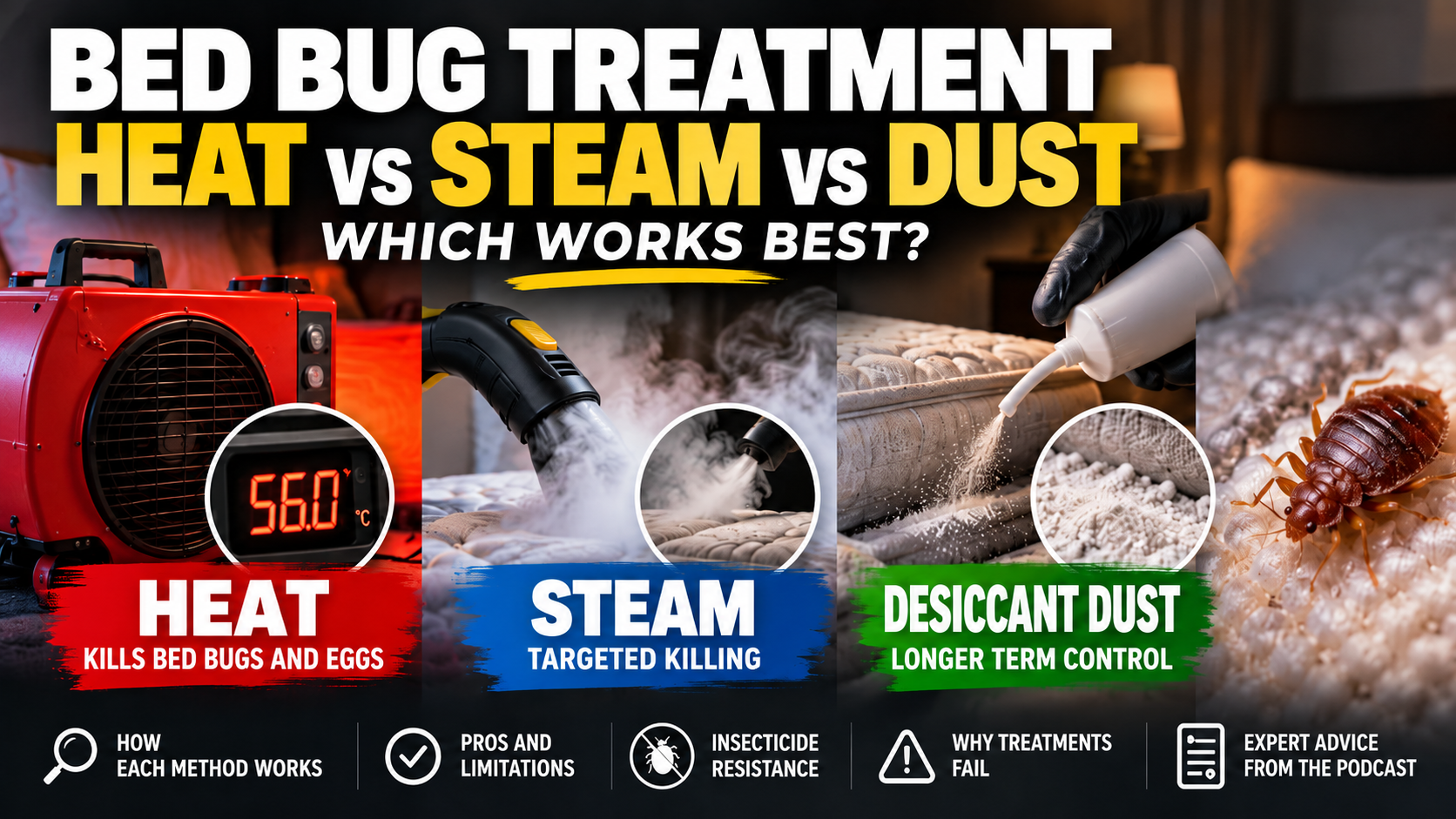
Bed Bug Heat Treatment vs Steam vs Desiccant Dust
Related Episode
083:Bed Bug Treatment: Are We Getting It Wrong? | Leah DarbyBed Bug Heat Treatment vs Steam vs Desiccant Dust: Which Works Best?
Bed bug heat treatment, professional steam and desiccant dust can all play important roles in controlling bed bug infestations. However, each method works differently, has its own limitations and requires the correct application to achieve successful results.
So, which approach is best? Can heat treatments eliminate bed bugs in one visit? Is steam sufficient on its own? And could desiccant dust offer an effective alternative to conventional insecticides?
These are questions increasingly discussed throughout the pest management industry, particularly as professionals look at how insecticide resistance, bed bug behaviour and treatment techniques influence success.
On Pest Perspectives Podcast, host Shaun Muller has explored these subjects with specialist guests including Brad Harvey from Trio Pest Control, Leah Darby from Complete Bed Bug Solutions and Richard Barrie from The Bed Bug Experts.
Their discussions highlight something important: successful bed bug management is not simply about choosing a treatment. It is about understanding the infestation, identifying harbourages and selecting methods that can effectively reach the insects.
Why Are Bed Bugs So Difficult to Eliminate?
Bed bugs (Cimex lectularius) are small, blood-feeding insects capable of hiding in extremely narrow cracks and crevices.
Although commonly associated with mattresses, they may also be found in:
- Bed frames, headboards and joints
- Mattress seams and surrounding furniture
- Skirting boards and small structural gaps
- Sofas, chairs and upholstered furniture
- Cracks around bedroom fittings and other harbourages
Bed bugs spend much of their time concealed, emerging periodically to feed.
This behaviour makes control particularly challenging because a treatment must reach the insects or create conditions in which they will encounter an effective control measure.
A bed bug infestation may also involve adults, nymphs and eggs, all of which need to be considered when developing a treatment programme.
A successful treatment must address the infestation as a whole, rather than simply killing the bed bugs that are visible during an inspection.
1. Professional Bed Bug Heat Treatment: How Does It Work?
Professional bed bug heat treatment involves raising temperatures within a room or controlled treatment area to levels lethal to bed bugs.
Specialist equipment generates and distributes heat, while temperature sensors help technicians monitor conditions throughout the treated space.
When all life stages are exposed to sufficient temperatures for the necessary period, heat can kill bed bugs, including their eggs.
However, there is an important distinction between the temperature of the air inside a room and the temperature actually reaching a bed bug.
Why Temperature Monitoring Is Essential
A room may feel extremely hot while parts of furniture, mattresses or concealed harbourages remain cooler.
These cooler areas can provide opportunities for bed bugs to survive.
Effective professional heat treatment therefore depends on:
- Achieving appropriate temperatures
- Maintaining sufficient exposure times
- Managing airflow throughout the space
- Ensuring heat reaches concealed harbourages
- Using appropriate monitoring equipment
Can Heat Treatment Eliminate Bed Bugs in One Visit?
Yes, a properly performed heat treatment can potentially eliminate an infestation in a single treatment session, provided all bed bugs and eggs receive sufficient lethal exposure. However, success cannot be guaranteed simply because the room has been heated.
Poor heat penetration, unsuitable preparation, inaccessible harbourages or the introduction of bed bugs from untreated areas can result in continued activity.
Expert Perspective: Brad Harvey
In Pest Perspectives Podcast Episode 85, Shaun Muller speaks with Brad Harvey from Trio Pest Control and Tales From The Crawlspace 2.0 about the complete professional heat treatment process.
Brad discusses specialist equipment, temperature monitoring, cold spots and why proper preparation is essential.
The conversation also explores what can go wrong during heat treatment and why experience matters when managing complex infestations.
“Listen: Bed Bug Heat Treatments Explained – Brad Harvey”
Listen to the full episode
2. Steam Treatment for Bed Bugs: What Are the Advantages?
Professional steam treatment is another method used in bed bug management.
Unlike whole-room heat treatment, steam allows technicians to apply concentrated heat to selected surfaces and harbourages.
When properly applied, steam can kill bed bugs and eggs that receive adequate lethal exposure.
It can be particularly useful when treating accessible areas such as mattress seams, upholstered furniture, bed-frame joints and other identified harbourages, where the material and equipment are suitable.
However, steam treatment has an important limitation.
Steam Has No Residual Killing Effect
Once the treated surface has cooled, steam provides no continuing control against bed bugs that subsequently move into the area.
Any insects or eggs that have escaped adequate heat exposure may survive.
This means steam treatment depends heavily on thorough inspection and careful application.
Steam may also have difficulty reaching insects concealed deep inside certain materials or inaccessible cavities.
Incorrect use can damage delicate surfaces and introduce unwanted moisture.
Can Steam Alone Eliminate Bed Bugs?
Steam can be highly effective against accessible bed bugs, but relying exclusively on steam may leave untreated harbourages.
For this reason, professional treatment strategies may combine steam with inspection, vacuuming, appropriate residual products or other control measures.
The combination should be planned carefully. For example, moisture from steaming can affect the performance of some dust formulations, so treatment order and product instructions matter.
Expert Perspective: Leah Darby
In Episode 83 of Pest Perspectives, Leah Darby from Complete Bed Bug Solutions discusses why understanding bed bug behaviour is essential.
One of the subjects explored is the limitation of relying on steam alone.
Leah explains how detailed inspections, understanding harbourages and selecting complementary treatment methods can improve the overall approach.
Her discussion also examines why repeated treatments may fail when the underlying problem has not been properly investigated.
Listen to Leah Darby – Bed Bug Treatment Strategies
3. Desiccant Dust for Bed Bugs: How Does It Work?
Desiccant dusts are receiving considerable attention within professional bed bug management.
Rather than relying on the same mechanisms as conventional neurotoxic insecticides, these products act physically on the insect’s protective outer layer, causing moisture loss and eventual death through dehydration.
Different formulations include products based on silica dioxide or diatomaceous earth.
However, these materials are not automatically interchangeable. Their performance can vary according to formulation, exposure, humidity and application.
Why Are Desiccant Dusts Attracting Interest?
One reason is their different mode of action.
Some bed bug populations show resistance to commonly used insecticide active substances, particularly certain pyrethroids.
Because desiccant dusts act physically, they may remain useful against insects resistant to conventional insecticides.
That does not mean every desiccant product works equally well, or that insects cannot show differences in susceptibility.
Exposure remains essential.
A dust cannot control insects that never come into effective contact with it.
What Does UK Research Say?
Research discussed by the Bed Bug Foundation and published through the British Pest Control Association has compared the performance of different desiccant materials.
The findings highlight important differences between diatomaceous earth and synthetic silica formulations, particularly under varying humidity and exposure conditions.
Some silica-based formulations demonstrated strong performance in laboratory testing, although real-world results still depend on how insects encounter the treatment.
This makes product selection, application technique and understanding bed bug behaviour especially important.
Are Desiccant Dusts Safe?
The term physical mode of action should not be confused with completely harmless.
Dust inhalation, incorrect application and unsuitable placement can create unnecessary exposure risks.
Products intended to control insects may fall under biocidal product requirements, even when they work physically rather than through conventional insecticide chemistry.
Professional users should check the product’s applicable UK regulatory status, follow its instructions and assess the risks before application.
Expert Perspective: Leah Darby and ChinChex
During her Pest Perspectives interview, Leah Darby discusses her experience using desiccant dusts, including ChinChex, as part of specialist bed bug programmes.
The episode explores product performance, insecticide resistance, treatment planning and the importance of follow-up visits.
Shaun also discusses how his own views on silica-based products developed after hearing research and practical experiences shared by industry specialists.
It is an interesting conversation about evaluating emerging approaches rather than relying on established habits alone.
Listen to Leah Darby – Bed Bug Treatment Strategies
Bed Bug Heat Treatment vs Steam vs Desiccant Dust: Comparison
Treatment method| Main advantage| Main limitation
Whole-room heat treatment| Can treat a large area and kill exposed bed bugs and eggs during a treatment session| Requires specialist equipment, temperature monitoring and effective heat penetration
Professional steam| Provides targeted killing of bed bugs and eggs receiving adequate heat exposure| No residual effect and may not reach concealed insects
Desiccant dust| Can provide continuing control in suitable treated harbourages as insects encounter the dust| Effectiveness depends on formulation, application and sufficient exposure
No single method should automatically be considered the best solution for every infestation.
The severity of the infestation, property layout, accessible harbourages, environmental conditions and risk assessment all influence treatment selection.
Why Do Some Bed Bug Treatments Fail?
One of the most important questions facing pest controllers is why infestations sometimes persist despite repeated treatments.
Potential reasons include:
Incorrect identification: Treatment begins without confirming that bed bugs are actually present.
Incomplete inspection: Concealed populations remain undetected.
Poor application: Heat, steam or residual products fail to reach the relevant harbourages.
Insecticide resistance: The selected insecticide is less effective against the population being treated.
Reinfestation: Bed bugs are introduced again or move from untreated neighbouring accommodation.
Insufficient monitoring: Continued activity goes unnoticed or a treatment is assumed successful too early.
These problems show why a treatment programme needs to be based on evidence rather than routine application alone.
During his conversation with Leah Darby, Shaun discusses a particularly concerning example involving a resident who, according to Leah, had experienced 21 insecticide treatments over 14 months without the wider problem being resolved.
The example raises an important professional question:
At what point should a pest controller stop repeating the same treatment and reassess the entire strategy?
Can Different Bed Bug Treatments Be Combined?
Yes. Integrated pest management can involve combining methods where appropriate.
Depending on the circumstances, this might include a detailed inspection, vacuuming, targeted steam, professional heat treatment, suitable residual products, mattress encasements and follow-up monitoring.
However, combining methods does not automatically guarantee better results.
Each method must be compatible with the overall programme and the conditions in which it is being used.
For example, professionals need to consider whether steam moisture could interfere with a subsequently applied or existing dust treatment.
The aim should be to select complementary measures that address identified risks and harbourages.
How Do You Know When Bed Bugs Have Been Eliminated?
The absence of visible bed bugs immediately after treatment is encouraging, but it does not always confirm elimination.
Follow-up inspections can help determine whether activity continues.
Technicians may look for:
- Live bed bugs or newly emerged nymphs
- Fresh spotting and other evidence
- Insects captured in suitable monitoring devices
- Reported sightings supported by further inspection
Bites alone are not a reliable way to confirm either the presence or elimination of bed bugs.
The monitoring programme should reflect the infestation, treatment method and circumstances of the property.
This is especially important in hotels, flats, student accommodation and other buildings where people or belongings move regularly between rooms.
Frequently Asked Questions About Bed Bug Treatments
What is the most effective professional bed bug treatment?
There is no universal best treatment. Professional heat, targeted steam and appropriately selected residual products can all be effective when used correctly. The best strategy depends on inspection findings, the extent of the infestation and the ability to reach the insects.
Does heat treatment kill bed bug eggs?
Yes. Bed bug eggs can be killed through sufficient heat exposure, provided the necessary temperatures reach their location for the required time.
Does steam kill bed bugs instantly?
Steam can kill bed bugs rapidly when adequate lethal heat reaches them, but effectiveness depends on the temperature achieved at the insect, exposure time and the material being treated.
Do desiccant dusts work against insecticide-resistant bed bugs?
Desiccant dusts have a physical mode of action that differs from conventional neurotoxic insecticides. This makes them potentially valuable against resistant populations, although effectiveness depends on formulation and exposure.
Can bed bugs return after professional treatment?
Yes. Bed bugs may survive in untreated harbourages, or new insects may be introduced from luggage, belongings or neighbouring accommodation. Follow-up inspections help identify continued or new activity.
Should all bed bug infestations receive the same treatment?
No. A professional treatment plan should reflect the infestation, property conditions, possible resistance, available control methods and the client’s circumstances.
What Can the Pest Control Industry Learn From These Different Approaches?
Perhaps the biggest lesson is that bed bug management continues to evolve.
Research into insecticide resistance, physical treatment methods and bed bug behaviour is encouraging professionals to reconsider how they manage infestations.
Heat treatment specialists emphasise temperature, exposure time and penetration.
Professionals using steam highlight precision and the importance of identifying harbourages.
Those working with desiccant dusts focus on physical modes of action, appropriate exposure and residual control.
These perspectives are not necessarily in opposition.
They demonstrate that effective pest management requires more than familiarity with one treatment technique.
Successful bed bug control depends on inspection, evidence, suitable treatment selection and ongoing assessment.
Listen to More Bed Bug Experts on Pest Perspectives Podcast
Pest Perspectives Podcast brings together pest control specialists, researchers, technicians and business owners to discuss the real challenges facing professional pest management.
Hosted by Shaun Muller in the United Kingdom, the independent podcast features practical conversations with guests from the UK and international pest control industry.
Discover specialist equipment, temperature monitoring, heat penetration and common reasons treatments fail.
For more detailed discussions, explore these episodes and articles:
Listen to Brad Harvey – Bed Bug Heat Treatments
Listen to Leah Darby – Bed Bug Treatment Strategies
Listen to Richard Barrie – Professional Bed Bug Heat Treatment
Listen to the ChinChex Bed Bug Control Expert Roundtable
Listen to Martin Cobbold – Professional Fumigation Explained
Follow Pest Perspectives Podcast
Whether you’re an experienced pest controller, a business owner, a technician developing your knowledge or someone interested in modern pest management, Pest Perspectives offers discussions with people working directly in the industry.
Listen, follow and subscribe on Spotify, Apple Podcasts and YouTube to discover more expert conversations about pest management.
Visit “Pest Perspectives Podcast” (https://www.pestperspectivespodcast.co.uk/) to explore the latest episodes.